CJC-1295 vs Ipamorelin vs Sermorelin 2026: Full Comparison
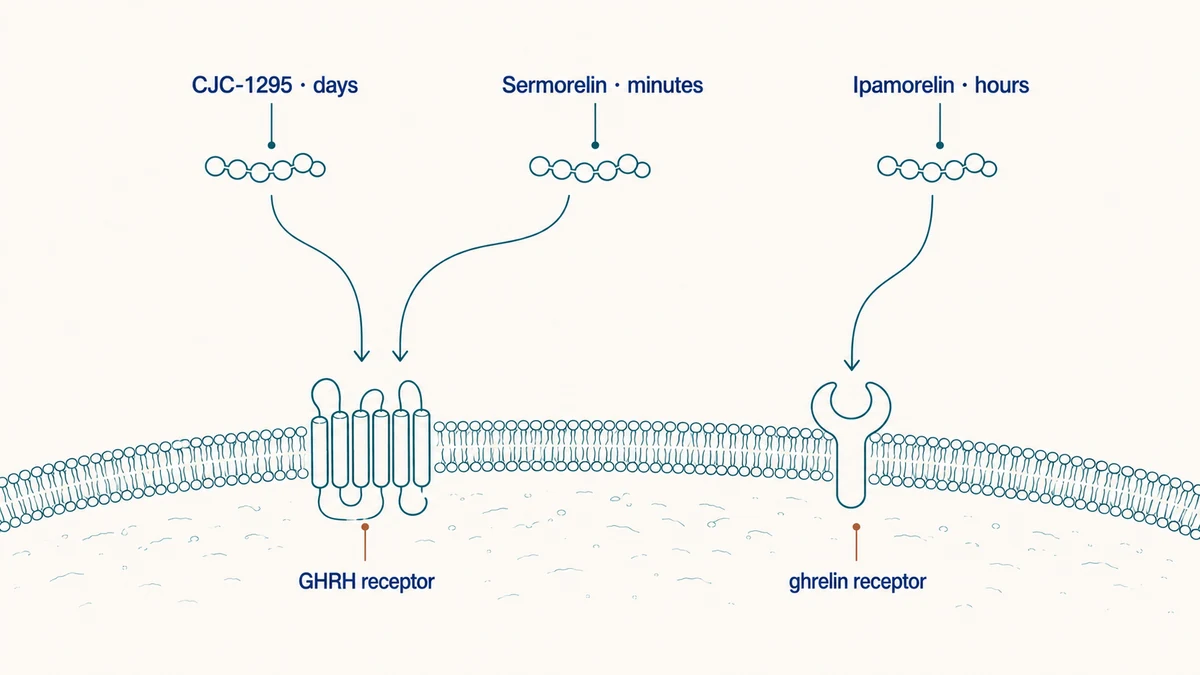
CJC-1295, Ipamorelin, and Sermorelin are the three most frequently investigated synthetic peptides in the growth-hormone (GH) axis research space. They are routinely grouped together in popular peptide commentary as 'GH peptides', but mechanistically they are not interchangeable. CJC-1295 (in both its DAC and no-DAC forms) and Sermorelin are GHRH analogs - synthetic variants of growth-hormone-releasing hormone that act on the pituitary GHRH receptor. Ipamorelin, by contrast, is a selective ghrelin / GHSR agonist that activates an entirely separate receptor system on the same somatotroph cells.
This distinction matters for research design. GHRH analogs and ghrelin agonists drive pituitary GH release through complementary, non-redundant pathways - the basis for the long-standing research interest in stacking compounds from the two classes. Within the GHRH-analog class, CJC-1295 with the drug affinity complex (DAC) modification, CJC-1295 without DAC (often labeled Mod GRF 1-29), and Sermorelin differ primarily in pharmacokinetics: half-lives span four orders of magnitude across the three.
This article compares all three head-to-head across receptor class, pharmacokinetics, published evidence, and protocol-design implications. It is written strictly for research-context decision support. All dose figures cited are reproduced from published animal and in vitro studies for protocol-design reference only - nothing in this document constitutes a recommendation for human use. See our research disclaimer for full context.
Quick Comparison Table
The table below summarizes the principal differences between the three compounds (with CJC-1295 split into its DAC and no-DAC forms, since they behave very differently). Each row is expanded in the sections that follow. Dose ranges are reproduced from published animal and in vitro work and are not human dosing recommendations.
| Compound | Class | Length | Plasma half-life | Pulsatility | Research dose range (rodent / in vitro) | Product page |
|---|---|---|---|---|---|---|
| CJC-1295 (DAC) | GHRH analog + albumin-binding DAC | 30 aa + DAC | ~6-8 days | Sustained GH/IGF-1 elevation | 30-60 µg/kg weekly equiv. (animal) | cjc-1295-dac |
| CJC-1295 (no DAC) / Mod GRF 1-29 | GHRH analog | 29 aa | ~30 minutes | Pulsatile | 100 µg per dose, 2-3×/day (animal) | mod-grf-1-29 |
| Ipamorelin | Selective ghrelin / GHSR agonist | 5 aa | ~2 hours | Pulsatile | 100-300 µg per dose, 2-3×/day (animal) | ipamorelin |
| Sermorelin | GHRH(1-29)NH₂ analog | 29 aa | ~10-15 minutes | Pulsatile | 1-10 µg/kg (animal) | n/a |
For the parallel review of CJC-1295 + Ipamorelin stacking, see CJC-1295 and Ipamorelin: Optimizing Growth Hormone Release.
Mechanism - Three Pathways, Two Receptor Systems
The clearest distinction across the three compounds is receptor class. CJC-1295 and Sermorelin both bind the GHRH receptor (GHRHR) on pituitary somatotrophs; Ipamorelin binds the growth hormone secretagogue receptor (GHSR-1a), which is the ghrelin receptor. The two receptor systems converge on GH release but use different intracellular signaling and respond to different physiological inputs. The subsections below summarize each pathway.
GHRH Analogs: CJC-1295 and Sermorelin
Sermorelin is the synthetic 29-amino-acid N-terminal fragment of endogenous human GHRH - GHRH(1-29)NH₂ - which retains the full biological activity of the 44-residue parent peptide. CJC-1295 is a further-modified GHRH(1-29)NH₂ in which four residue substitutions (D-Ala², Gln⁸, Ala¹⁵, Leu²⁷) confer enzymatic stability against DPP-IV and other proteases. CJC-1295 with DAC additionally carries a drug affinity complex - a maleimidopropionic acid linker that forms a covalent bond with circulating serum albumin via cysteine-34, dramatically extending plasma half-life. All three compounds bind GHRHR and stimulate GH release through Gαs-coupled adenylate cyclase activation and cAMP-driven somatotroph exocytosis (Frohman & Jansson 1986; Teichman et al. 2006). The downstream physiology - pulsatile GH release with subsequent hepatic IGF-1 production - is qualitatively similar across all three.
Ghrelin / GHSR Agonists: Ipamorelin
Ipamorelin is a synthetic pentapeptide (Aib-His-D-2-Nal-D-Phe-Lys-NH₂) that binds the growth hormone secretagogue receptor 1a (GHSR-1a) - the same receptor activated by endogenous ghrelin. GHSR-1a is Gαq-coupled and signals through phospholipase C, IP₃, and intracellular calcium release rather than the cAMP pathway used by GHRHR. Ipamorelin was characterized by Raun et al. (1998) at Novo Nordisk as a 'second-generation' GHRP designed for selectivity: unlike GHRP-2 or GHRP-6, Ipamorelin produces minimal elevation of cortisol, prolactin, ACTH, or aldosterone at doses that produce clear GH release. This selectivity profile is the principal reason Ipamorelin remains the most widely used research-grade GHSR agonist despite having lower absolute potency than GHRP-2.
Why the Combination Is Interesting in Research
Bowers and colleagues (1991, 2004) established that GHRH analogs and ghrelin/GHRP-class agonists produce synergistic - not merely additive - GH release when co-administered. The mechanism is two-fold: GHRH agonism increases cAMP-driven exocytosis from somatotrophs, while GHSR-1a agonism simultaneously increases the size of the GH-releasable pool and amplifies the calcium signal. Co-administration in healthy and GH-deficient subjects produces GH peaks substantially larger than either compound alone at matched doses. This is the mechanistic basis for the long-standing research interest in GHRH + GHRP combinations - the most widely studied being CJC-1295 (no DAC) + Ipamorelin (see stacking review).
Pharmacokinetics & Pulsatility
The three compounds (or four, counting CJC-1295 DAC and no-DAC separately) span four orders of magnitude in plasma half-life. This is the single most important variable in protocol design.
Sermorelin has the shortest half-life - approximately 10-15 minutes in humans after subcutaneous administration (Prakash & Goa 1999). This very short exposure preserves natural pulsatile GH release: GH peaks rise and fall on physiological timescales, and somatostatin tone modulates response between doses. Sermorelin was approved by the FDA in 1990 (Geref) for diagnostic and therapeutic use in pediatric GH deficiency before being discontinued for commercial reasons in 2008.
CJC-1295 without DAC (Mod GRF 1-29) has a half-life of approximately 30 minutes in rats and humans - longer than Sermorelin due to the four protease-resistant substitutions, but still pulsatile in profile. This compound was originally characterized in the Teichman et al. (2006) studies as the 'short-acting' GHRH analog and is the preferred GHRH-class partner for stacking with Ipamorelin in research protocols designed to mimic native pulsatility.
CJC-1295 with DAC extends plasma half-life to approximately 6-8 days by covalent binding to serum albumin (Teichman et al. 2006; Ionescu & Frohman 2006). At this exposure, GHRHR is tonically activated and pulsatile GH release is replaced by sustained elevation of mean GH and IGF-1 over multi-day to multi-week timescales. This is mechanistically a different research tool from the no-DAC variant - useful for studies of sustained GH/IGF-1 axis stimulation, but not appropriate for protocols designed to preserve natural pulsatility. Concerns about somatotroph desensitization and tachyphylaxis with chronic CJC-1295 DAC dosing are documented in the broader GHRH-analog literature.
Ipamorelin has a plasma half-life of approximately 2 hours after subcutaneous administration in animals (Raun et al. 1998), placing it between the short GHRH analogs and CJC-1295 DAC. Its effective duration of action on GH release is shorter than 2 hours due to GHSR-1a desensitization kinetics, which is why research protocols typically dose 2-3 times daily.
Research Evidence Side-by-Side
The three compounds have different evidence bases reflecting their respective receptor classes and clinical histories. The subsections below summarize the strongest published evidence for each compound by research aim.
GH and IGF-1 Elevation Studies
All three compounds produce documented GH elevation in animal and human research. Sermorelin has the deepest published clinical record by virtue of its 1990s-era FDA approval - Thorner and colleagues published extensively on GHRH(1-29)NH₂ in GH-deficient children and adults through the 1980s and 1990s. CJC-1295 with DAC produces the largest sustained IGF-1 elevations of the three, with Teichman et al. (2006) reporting dose-dependent IGF-1 increases lasting 7+ days after a single subcutaneous dose in healthy adults. Ipamorelin alone produces clear GH peaks but more modest IGF-1 elevation than CJC-1295 DAC; its strongest GH/IGF-1 data appear in combination studies with GHRH-class agonists (Bowers 2004; Raun et al. 1998).
Body Composition Research (Animal Models)
Animal-model research on body composition with these compounds is most developed for Ipamorelin and CJC-1295 in combination, where the synergistic GH peaks translate to documented effects in rodent models. Solo-compound body-composition data are thinner. Sermorelin's clinical record in pediatric GH deficiency provides the most rigorous human composition data of the three, but those endpoints address pathological GH deficiency rather than the research questions typically pursued in adult animal models.
Sleep and Recovery Research
GHRH analogs have a well-documented effect on slow-wave sleep (SWS) - Steiger and colleagues published extensively on GHRH-induced increases in SWS in healthy adults through the 1990s and 2000s. Sermorelin and short-acting CJC-1295 are the GHRH analogs most commonly cited in this literature. Ipamorelin and other GHSRs have a less consistent SWS profile; ghrelin itself has effects on sleep architecture, but the selective GHSR-1a profile of Ipamorelin does not reproduce them as cleanly as full ghrelin.
Cognitive and Neurological Research
Ghrelin and ghrelin-receptor agonists - including Ipamorelin - have published data on hippocampal function, memory consolidation, and neuroprotection in rodent models (Diano et al. 2006). GHRH analogs have less developed cognitive data, although Vitiello and colleagues have published on GHRH-induced cognitive effects in older adults. Within this comparison set, Ipamorelin is the compound with the more substantial neurological literature, though the field is still developing.
Stacking - When Researchers Use Combinations
The classic research stack in this space is CJC-1295 (no DAC / Mod GRF 1-29) plus Ipamorelin, typically dosed together 2-3 times daily in animal protocols. The rationale, established by the Bowers GHRH+GHRP synergy literature, is mechanistic complementarity: simultaneous GHRHR (Gαs/cAMP) and GHSR-1a (Gαq/IP₃/Ca²⁺) activation produces GH peaks substantially larger than either compound alone, while preserving the pulsatile profile that solo CJC-1295 DAC eliminates. Sermorelin can substitute for Mod GRF 1-29 in this stack; its shorter half-life makes the pulse profile slightly sharper but the overall research conclusion is similar.
CJC-1295 DAC plus Ipamorelin is occasionally encountered in research protocols but is mechanistically inconsistent - the sustained GHRHR tone from DAC negates the pulsatility benefit of pairing with a short-acting GHSR agonist. Investigators studying sustained GH/IGF-1 elevation should use CJC-1295 DAC alone; investigators studying pulsatile mimicking should use the no-DAC GHRH analog plus Ipamorelin.
Safety, Regulatory Status, and Research Gaps
None of the three compounds - in the synthetic forms sold as research peptides - is currently approved by the FDA or EMA for human therapeutic use. Sermorelin was approved by the FDA in 1990 under the brand name Geref for pediatric GH deficiency diagnosis and therapy, but Serono discontinued the product in 2008 for commercial reasons; the molecule retained its safety dossier but is no longer commercially available as an approved drug. CJC-1295 (both DAC and no-DAC) has never been approved; clinical development was conducted by ConjuChem in the mid-2000s and did not proceed to registration. Ipamorelin was developed by Novo Nordisk and Helsinn through phase II for postoperative ileus before being discontinued.
Documented safety concerns specific to this class include tachyphylaxis with sustained GHRH receptor activation (most relevant to CJC-1295 DAC), somatotroph desensitization with chronic GHRP administration, and the broader concern that sustained GH/IGF-1 elevation may have effects on insulin sensitivity and IGF-1-responsive tissues that have not been characterized in long-term studies. All compounds should be treated as research tools only. See our research disclaimer for full framing.
How to Choose for Your Research
The decision between these compounds depends on the biological question and the desired GH profile, not on which compound is broadly 'better'. The following framework summarizes the design implications:
- Studying sustained GH / IGF-1 elevation over multi-day timescales? CJC-1295 with DAC is the only compound in this set that produces this exposure profile. Use it alone - pairing with a short-acting GHSR agonist is mechanistically inconsistent.
- Studying pulsatile GH release that mimics endogenous physiology? Use CJC-1295 without DAC (Mod GRF 1-29) plus Ipamorelin, dosed together 2-3 times daily. This is the classic pulsatile-mimicking research stack.
- Studying short-acting GHRH stimulation alone, without a ghrelin component? Sermorelin (where available) or Mod GRF 1-29 are appropriate. Sermorelin's shorter half-life produces sharper pulses; Mod GRF 1-29 is more protease-stable.
- Studying GHSR-1a / ghrelin pathway biology specifically? Ipamorelin is the cleanest tool - selective GHSR-1a agonist with minimal off-target hormone effects.
- Studying neurological or cognitive effects of GH-axis modulation? Ipamorelin has the more developed literature for non-GH effects on hippocampal and memory endpoints.
This is a research-selection framework. Nothing in this section is a recommendation for human use of any compound; all remain strictly research-use-only.
Conclusion
CJC-1295, Ipamorelin, and Sermorelin are often grouped together as 'GH peptides', but the peer-reviewed literature treats them as distinct tools with different receptor classes, different pharmacokinetic profiles, and different evidence bases. Sermorelin and CJC-1295 are GHRH analogs acting on the GHRH receptor; Ipamorelin is a selective ghrelin / GHSR-1a agonist. Within the GHRH-analog class, CJC-1295 with DAC produces sustained multi-day GH/IGF-1 elevation, CJC-1295 without DAC and Sermorelin produce short-acting pulsatile responses.
The right compound depends on the research question. For sustained GH/IGF-1 axis stimulation, CJC-1295 DAC alone is the appropriate tool. For pulsatile-mimicking research, the Mod GRF 1-29 + Ipamorelin stack is the classic protocol. For ghrelin-pathway-specific work, Ipamorelin alone is the cleanest tool. All use must remain within research-only boundaries - none of these compounds, in their current research-peptide forms, is approved by the FDA or EMA. Batch-level Certificate of Analysis review is essential before incorporating any of these peptides into a study protocol.
Source this peptide for your research
Order CJC-1295 (DAC) at Particle PeptidesResearch source
Source CJC-1295 (DAC) for your research
Lab-tested, ≥99% HPLC purity. Certificate of Analysis available per batch.
View productFrequently Asked Questions
What's the difference between CJC-1295 with and without DAC?
DAC (drug affinity complex) is a maleimidopropionic acid linker covalently attached to the GHRH analog peptide. After injection, DAC binds to circulating serum albumin via cysteine-34, dramatically extending plasma half-life from approximately 30 minutes (no DAC, also called Mod GRF 1-29) to approximately 6-8 days (with DAC). The biological consequence is profound: no-DAC variants produce short pulsatile GH release that mimics native physiology, while DAC variants produce sustained multi-day GH and IGF-1 elevation. The two are different research tools for different questions.
Are these the same as actual human growth hormone (HGH)?
No. HGH (somatropin) is the 191-amino-acid pituitary hormone itself. CJC-1295, Ipamorelin, and Sermorelin are all secretagogues - they trigger the pituitary to release endogenous GH, but they are not GH themselves. Mechanistically this is an important distinction: secretagogues depend on a functional pituitary somatotroph response, retain feedback regulation by somatostatin and IGF-1, and produce GH on a more physiological release pattern than exogenous recombinant HGH.
Is Ipamorelin a GHRH analog?
No - Ipamorelin is frequently mislabeled as a GHRH analog in popular peptide commentary, but it is mechanistically a separate class. Ipamorelin is a selective ghrelin / GHSR-1a agonist, acting on the growth hormone secretagogue receptor - a different receptor system from the GHRH receptor that CJC-1295 and Sermorelin target. The two receptor classes converge on GH release but use different intracellular signaling (Gαs/cAMP for GHRHR, Gαq/IP₃/Ca²⁺ for GHSR-1a). This mechanistic distinction is the basis for stacking compounds from the two classes.
Sermorelin vs CJC-1295: which has more research?
Sermorelin has the deeper clinical literature - it was an FDA-approved drug (Geref) from 1990 to 2008 for pediatric GH deficiency, with extensive published clinical data on safety and efficacy in that population. CJC-1295 (both forms) was developed by ConjuChem in the mid-2000s and has a smaller published clinical record, primarily the Teichman 2006 phase I studies. For research applications requiring the most established GHRH-analog dossier, Sermorelin's clinical record is deeper; for research applications requiring sustained multi-day GH/IGF-1 elevation, CJC-1295 with DAC is the only compound in this class with that pharmacokinetic profile.
Is the CJC-1295 + Ipamorelin stack still relevant in research?
Yes - the CJC-1295 (no DAC) + Ipamorelin stack remains the most widely used research protocol for studying synergistic GHRH+GHRP-class GH release in animal models. The Bowers GHRH+GHRP synergy literature establishes the mechanistic basis, and the practical convenience of the two-compound protocol with matched pulsatile profiles keeps it relevant. Note that pairing CJC-1295 with DAC and Ipamorelin is mechanistically inconsistent - the sustained GHRHR tone from DAC negates the pulsatility-preserving rationale for pairing with a short-acting GHSR agonist.
Where can I source research-grade material?
Reputable research suppliers certify GH-axis peptides at ≥99% purity by HPLC with mass spectrometry confirmation on a per-batch basis. Always review the Certificate of Analysis for the specific lot before incorporating any of these peptides into a study protocol. Baltic BioLabs publishes batch-level lab reports for its CJC-1295 (DAC), Mod GRF 1-29, and Ipamorelin lines.
Scientific References
- Frohman LA, Jansson JO. Growth hormone-releasing hormone. Endocr Rev. 1986;7(3):223-253
- Teichman SL, Neale A, Lawrence B, Gagnon C, Castaigne JP, Frohman LA. Prolonged stimulation of growth hormone (GH) and insulin-like growth factor I secretion by CJC-1295, a long-acting analog of GH-releasing hormone, in healthy adults. J Clin Endocrinol Metab. 2006;91(3):799-805. PMID: 16352683[PubMed Reference]
- Ionescu M, Frohman LA. Pulsatile secretion of growth hormone (GH) persists during continuous stimulation by CJC-1295, a long-acting GH-releasing hormone analog. J Clin Endocrinol Metab. 2006;91(12):4792-4797. PMID: 17018654[PubMed Reference]
- Raun K, Hansen BS, Johansen NL, Thøgersen H, Madsen K, Ankersen M, Andersen PH. Ipamorelin, the first selective growth hormone secretagogue. Eur J Endocrinol. 1998;139(5):552-561. PMID: 9849822[PubMed Reference]
- Bowers CY, Granda R, Mohan S, Kuipers J, Baylink D, Veldhuis JD. Sustained elevation of pulsatile growth hormone (GH) secretion and insulin-like growth factor I (IGF-I), IGF-binding protein-3 (IGFBP-3), and IGFBP-5 concentrations during 30-day continuous subcutaneous infusion of GH-releasing peptide-2 in older men and women. J Clin Endocrinol Metab. 2004;89(5):2290-2300. PMID: 15126555[PubMed Reference]
- Bowers CY, Reynolds GA, Durham D, Barrera CM, Pezzoli SS, Thorner MO. Growth hormone (GH)-releasing peptide stimulates GH release in normal men and acts synergistically with GH-releasing hormone. J Clin Endocrinol Metab. 1990;70(4):975-982. PMID: 2108187[PubMed Reference]
- Prakash A, Goa KL. Sermorelin: a review of its use in the diagnosis and treatment of children with idiopathic growth hormone deficiency. BioDrugs. 1999;12(2):139-157. PMID: 18031173[PubMed Reference]
- Smith RG, Van der Ploeg LH, Howard AD, et al. Peptidomimetic regulation of growth hormone secretion. Endocr Rev. 1997;18(5):621-645. PMID: 9331545[PubMed Reference]
- Kojima M, Hosoda H, Date Y, Nakazato M, Matsuo H, Kangawa K. Ghrelin is a growth-hormone-releasing acylated peptide from stomach. Nature. 1999;402(6762):656-660. PMID: 10604470[PubMed Reference]
- Veldhuis JD, Bowers CY. Integrating GHS into the ghrelin system. Int J Pept. 2010;2010:879503. PMID: 20798846[PubMed Reference]
- Diano S, Farr SA, Benoit SC, et al. Ghrelin controls hippocampal spine synapse density and memory performance. Nat Neurosci. 2006;9(3):381-388. PMID: 16491079[PubMed Reference]
- Sinha DK, Pazderka C, Bronicki M, et al. Survey and meta-analysis of ipamorelin pharmacology and clinical development. Endocr Rev Suppl. 2017;38(3 Suppl):MON-505.
Related Research Peptides
CJC-1295 (DAC)
Ipamorelin