GHK-Cu vs Copper Peptide Complex
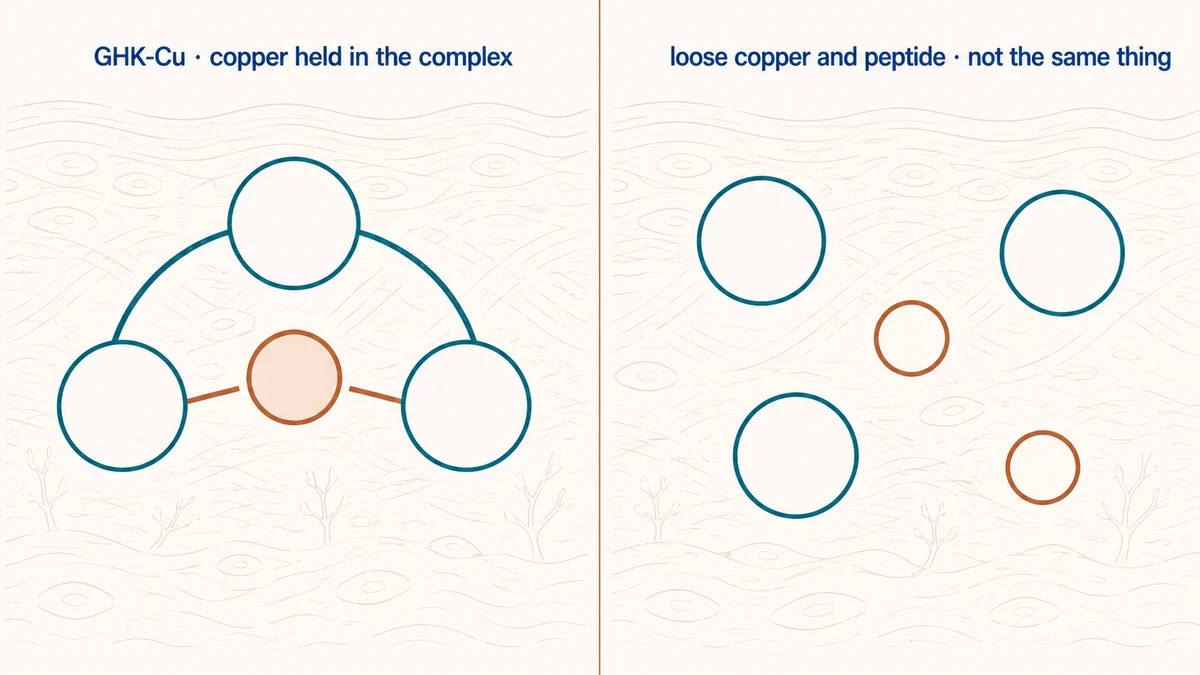
The terms GHK-Cu and Copper Peptide Complex appear side-by-side in research literature, cosmetic marketing, and supplier catalogs - and are routinely treated as synonymous. They are not. GHK-Cu is a structurally defined molecule: the tripeptide Gly-His-Lys in 1:1 coordination with a copper(II) ion, ~340 Da, with a sequence first characterized by Loren Pickart in 1973. "Copper Peptide Complex" is an industry / cosmetic marketing term that has no fixed definition. It is applied across proprietary oligopeptide-copper blends, branched copper-conjugated peptides of four to five residues, GHK-Cu admixed with carrier proteins, and in some cases simple copper-amino-acid chelates marketed under peptide branding.
For a researcher planning a reproducible experiment, this distinction is not cosmetic. A defined molecule with known sequence and decades of peer-reviewed mechanism work behaves predictably across labs; a proprietary blend with undisclosed composition does not. Substituting one for the other in a published protocol introduces uncontrolled variables that can fully account for any observed difference in outcome.
This article maps the practical differences between GHK-Cu and the broader "Copper Peptide Complex" category - what each term refers to, what mechanism evidence exists, and how to choose the appropriate tool for a given research question. All content is written strictly for in vitro and research-context decision support; see our research disclaimer.
Quick Comparison Table
The table below summarizes the principal differences between defined GHK-Cu and the broader "Copper Peptide Complex" category as those terms are used in supplier catalogs and the published literature. Each row is expanded in the sections that follow.
| Attribute | GHK-Cu | Copper Peptide Complex |
|---|---|---|
| Definition | Tripeptide Gly-His-Lys + Cu²⁺ in 1:1 coordination | Marketing / industry term, varied formulations |
| Sequence | Defined, conserved across literature | Variable, often proprietary or undisclosed |
| Molecular weight | ~340 Da | Variable; depends on formulation |
| Research evidence | Strong; decades of peer-reviewed mechanism work | Limited; mostly cosmetic / formulator data |
| Standardization | Yes - defined sequence, identifiable by HPLC + MS | No - varies by manufacturer and product line |
| Research-grade availability | Lyophilized vials, COA-backed | Rare in research-grade format; mostly cosmetic |
| Reproducibility across labs | High | Low - composition varies between products |
For batch-level identity and purity data on GHK-Cu specifically, see our published lab reports. For cross-comparison in skin and matrix biology research, the GHK-Cu anti-aging variant is the most commonly referenced research format.
What is GHK-Cu?
GHK-Cu is one of the few research peptides whose sequence, structure, and endogenous biology are all well-defined. It has been the subject of continuous peer-reviewed investigation for more than fifty years, and the major mechanistic claims rest on independent confirmation across multiple laboratories.
Discovery and Endogenous Role
GHK was first identified by Loren Pickart in 1973 during fractionation of human plasma in studies of age-dependent differences in hepatocyte gene expression. The active fraction was characterized as the tripeptide glycyl-L-histidyl-L-lysine, present in human plasma at approximately 200 ng/mL in young adults and declining substantially with age. The peptide is liberated from extracellular matrix proteins - including SPARC and several collagens - during normal tissue turnover and at sites of injury, positioning it as an endogenous matrikine: a matrix-derived signaling fragment that participates in tissue repair.
Structure and Copper Coordination
The peptide adopts a 1:1 coordination complex with copper(II), with the histidine imidazole, the N-terminal amine, and the deprotonated peptide-bond nitrogen between Gly and His acting as ligands. This coordination geometry is what distinguishes GHK-Cu from free GHK: the copper-bound form is the biologically active species characterized in the published in vitro and in vivo literature, and most research-grade material is supplied pre-complexed. The molecular weight of GHK-Cu is approximately 340 Da including the copper ion.
Why Copper Matters for Activity
Copper is not a passive carrier in the GHK-Cu complex. The copper ion participates in redox cycling between Cu²⁺ and Cu⁺, supports the activity of cuproenzymes such as superoxide dismutase 1 (SOD1) and lysyl oxidase (a key crosslinking enzyme in collagen and elastin maturation), and contributes to the gene-expression effects documented in the Pickart 2012 transcriptomic review. Removing copper from the complex eliminates a substantial fraction of the documented activity, which is one reason why "copper peptide" formulations that do not specify copper coordination chemistry are not interchangeable with defined GHK-Cu.
What "Copper Peptide Complex" Usually Means
"Copper Peptide Complex" is best understood as an umbrella marketing term rather than a defined chemical entity. In supplier catalogs it is applied across at least three formulation classes, and specific composition is frequently undisclosed.
The first class consists of proprietary oligopeptide-copper blends - short synthetic peptides of four to five residues, often branched or palmitoylated for skin penetration, conjugated to or co-formulated with copper salts. These are common in cosmetic products and are typically protected by trade names rather than by chemical disclosure.
The second class consists of GHK-Cu admixed with carrier proteins or other peptides, where the active GHK-Cu fraction is present but is not the sole peptide species. These products may behave qualitatively like GHK-Cu in some assays but cannot be substituted into a published GHK-Cu protocol with confidence.
The third class consists of simple copper-amino-acid chelates - for example, copper bisglycinate - marketed under peptide-adjacent branding. These are not peptides in the strict sense and lack GHK sequence-specific gene-expression effects.
The practical implication: a product labeled "Copper Peptide Complex" without explicit sequence and copper-coordination disclosure cannot be assumed equivalent to defined GHK-Cu. The Baltic BioLabs Copper Peptide Complex listing exists as a category placeholder; the GHK-Cu and GHK-Cu Anti-Aging lines are the defined-molecule research formats.
Mechanism - What's Actually Published
The published mechanism literature on GHK-Cu is substantial and reproducibly cited; the published mechanism literature on "Copper Peptide Complex" formulations is thin and dominated by formulator white papers rather than peer-reviewed experimental work. The two subsections below summarize each.
GHK-Cu - Defined Mechanism Evidence
The most comprehensive single mechanism review is *Pickart, Vasquez-Soltero & Margolina (2012, Pharmazie), which synthesizes data from the Broad Institute Connectivity Map showing that GHK-Cu treatment produces statistically significant modulation of more than 4,000 human genes, with a directional pattern consistent with a shift toward a younger transcriptomic signature. Specific mechanism strands with independent confirmation include: stimulation of collagen and glycosaminoglycan synthesis in dermal fibroblasts (Maquart et al., 1988, 1993; Siméon et al. 2000); wound-healing acceleration in rodent skin and corneal models; and copper-dependent support for lysyl oxidase activity, central to extracellular matrix crosslinking. Lane, Iruela-Arispe and Sage (1994, J Cell Biol) demonstrated that GHK is a SPARC-derived matricellular fragment, anchoring the endogenous-matrikine framing. Kang et al. (2009, Ann Dermatol)* reported hair-follicle promoting effects of GHK-Cu in a preclinical dermatological model.
Copper Peptide Complex - Limited Rigorous Evidence
Mechanism evidence for non-GHK "Copper Peptide Complex" formulations is dominated by formulator-generated cosmetic data - typically in-house keratinocyte assays, supplier white papers, and cosmetic-industry conference proceedings. Independent peer-reviewed mechanism work on undefined Cu-peptide blends is rare, and where it exists it generally reduces to the GHK-Cu fraction within the blend rather than to a distinct activity of the proprietary mixture. Researchers should treat any mechanism claim attached to a "Copper Peptide Complex" product as provisional until the active species has been chemically identified and the activity has been reproduced with the defined molecule.
Research Applications Side-by-Side
The published evidence base supports defined GHK-Cu across several research areas, while the "Copper Peptide Complex" category is largely untested in rigorous peer-reviewed work. The areas below are where the comparison is most relevant.
Skin and wound healing: GHK-Cu has decades of published evidence in fibroblast collagen synthesis, dermal wound closure, and corneal repair models. "Copper Peptide Complex" products carry similar marketing claims but typically without independent mechanism support.
Anti-aging gene expression: The Pickart 2012 Pharmazie review documenting >4,000 gene changes is specific to GHK-Cu. No equivalent transcriptomic dataset exists for proprietary copper-peptide blends.
Hair follicle research: GHK-Cu has published preclinical data (Kang 2009); cosmetic Cu-Complex products have been used in hair-care formulations, but rigorous mechanism evidence in this area remains weaker than the dermal literature.
Mitochondrial and redox biology: Emerging GHK-Cu work intersects with cuproenzyme biology and copper homeostasis. "Copper Peptide Complex" formulations vary too widely in copper content and coordination to support reproducible redox-biology research.
Choosing for Research
The choice between defined GHK-Cu and a "Copper Peptide Complex" product is determined by the reproducibility requirements of the research question.
If the goal is to reproduce or extend a published GHK-Cu finding - collagen induction, transcriptomic profiling, wound-healing kinetics, or hair-follicle biology - the only appropriate tool is defined GHK-Cu with sequence and copper-coordination confirmed by COA. Substituting an undefined Cu-peptide blend introduces uncontrolled variables that will compromise interpretability.
If the goal is to characterize a specific cosmetic formulation, then a Cu-Complex product may be the correct study material - but the formulation should be treated as the experimental object, not as a GHK-Cu surrogate, and composition should be documented to whatever level the supplier permits.
For most basic-research questions in matrix biology, dermal repair, and copper-peptide signaling, defined GHK-Cu is the appropriate research-grade tool.
Safety and Regulatory Considerations
GHK-Cu has a long-standing record of tolerability in topical and dermal cosmetic research and in published preclinical models. The principal safety considerations in research design are copper accumulation in long-term or systemic exposure protocols, and the potential for redox-active copper to participate in Fenton chemistry under conditions of compromised antioxidant capacity. These are protocol-design considerations, not contraindications.
"Copper Peptide Complex" products vary widely in copper content, peptide composition, and excipients, and safety extrapolations from the GHK-Cu literature do not necessarily transfer. Neither GHK-Cu nor any Cu-peptide blend is approved as a pharmaceutical for systemic human use. All such material is supplied for in vitro and research use only; see our research disclaimer.
Conclusion
GHK-Cu and "Copper Peptide Complex" are not the same thing. GHK-Cu is a structurally defined tripeptide-copper complex with decades of peer-reviewed mechanism work, including the Pickart 2012 transcriptomic review documenting >4,000 gene-expression changes, the Maquart and Siméon collagen-synthesis literature, and the Lane SPARC-derived matrikine characterization. "Copper Peptide Complex" is an industry marketing term covering proprietary blends and admixtures whose composition is typically undisclosed.
For reproducible research, the appropriate tool is defined GHK-Cu with COA-confirmed sequence and copper coordination. Cu-Complex products may be appropriate study material when the formulation itself is the research object, but they are not GHK-Cu surrogates. See our lab reports and research disclaimer.
Source this peptide for your research
Order GHK-Cu at Baltic PeptidesFrequently Asked Questions
Are GHK-Cu and Copper Peptide Complex the same thing?
No. GHK-Cu is a structurally defined tripeptide (Gly-His-Lys) in 1:1 coordination with copper(II), with a fixed sequence and a molecular weight of approximately 340 Da. "Copper Peptide Complex" is an industry marketing term that covers a range of formulations - proprietary oligopeptide-copper blends, GHK-Cu admixtures, and simple copper-amino-acid chelates - whose composition is often undisclosed. The two terms are not interchangeable in research.
Which has more peer-reviewed research?
GHK-Cu, by a wide margin. The defined molecule has been the subject of continuous peer-reviewed work since Pickart's 1973 isolation, including the 2012 Pharmazie transcriptomic review, the Maquart collagen-synthesis literature, and the Lane SPARC matrikine characterization. "Copper Peptide Complex" formulations, as a category, have very limited rigorous mechanism evidence outside formulator white papers.
Can I substitute a Copper Peptide Complex product for GHK-Cu in a research protocol?
Not without compromising reproducibility. A published GHK-Cu protocol assumes the defined Gly-His-Lys-Cu²⁺ molecule. Substituting an undefined Cu-peptide blend introduces uncontrolled variables - peptide sequence, copper coordination, excipients - that can fully account for any observed difference in outcome. If a study cites GHK-Cu, use COA-confirmed GHK-Cu.
Is GHK-Cu safer than Copper Peptide Complex products?
GHK-Cu has a longer and better-characterized tolerability record in topical and dermal research. "Copper Peptide Complex" products vary widely in copper content and excipient composition, so safety extrapolations from the GHK-Cu literature do not transfer reliably. Neither is approved as a pharmaceutical for systemic human use; both are research-use materials.
Where can I source research-grade GHK-Cu?
Reputable research suppliers certify GHK-Cu at ≥99% purity by HPLC, with identity confirmed by mass spectrometry on a per-batch basis, and supply the peptide pre-complexed with copper. Always review the Certificate of Analysis for the specific lot before incorporating into a study protocol. Baltic BioLabs publishes batch-level lab reports for its GHK-Cu and GHK-Cu Anti-Aging lines.
What COA standards should I expect for research-grade GHK-Cu?
A research-grade GHK-Cu COA should report HPLC purity (≥99%), mass spectrometric confirmation of the 340 Da GHK-Cu species, copper content consistent with 1:1 coordination stoichiometry, and lot-specific water content and counter-ion data. Sequence-only certification without copper-coordination data is insufficient for reproducing the Pickart-era literature.
Does the molecular weight of GHK-Cu vary between suppliers?
No - for the defined molecule, molecular weight is approximately 340 Da regardless of supplier, because the sequence and copper coordination are fixed. If a product labeled "GHK-Cu" reports a different molecular weight, it is either a non-GHK Cu-peptide blend or has been formulated with additional components, and should not be treated as equivalent to the defined molecule.
Scientific References
- Pickart L. The human tri-peptide GHK and tissue remodeling. J Biomater Sci Polym Ed. 2008;19(8):969-988. PMID: 18644225[PubMed Reference]
- Pickart L, Vasquez-Soltero JM, Margolina A. GHK peptide as a natural modulator of multiple cellular pathways in skin regeneration. Biomed Res Int. 2015;2015:648108. PMID: 26236730[PubMed Reference]
- Pickart L, Margolina A. Skin remodeling: GHK and its role in skin regeneration. Pharmazie. 2012;67(9):724-732. (Transcriptomic review of >4,000 GHK-Cu-modulated genes)
- Maquart FX, Bellon G, Pasco S, Monboisse JC. Matrikines in the regulation of extracellular matrix degradation. Biochimie. 2005;87(3-4):353-360. PMID: 15781322[PubMed Reference]
- Maquart FX, Pickart L, Laurent M, et al. Stimulation of collagen synthesis in fibroblast cultures by the tripeptide-copper complex glycyl-L-histidyl-L-lysine-Cu2+. FEBS Lett. 1988;238(2):343-346. PMID: 3169264[PubMed Reference]
- Lane TF, Iruela-Arispe ML, Johnson RS, Sage EH. SPARC is a source of copper-binding peptides that stimulate angiogenesis. J Cell Biol. 1994;125(4):929-943. PMID: 7514608[PubMed Reference]
- Kang YA, Choi HR, Na JI, et al. Copper-GHK increases integrin expression and p63 positivity by keratinocytes. Arch Dermatol Res. 2009;301(4):301-306
- Siméon A, Wegrowski Y, Bontemps Y, Maquart FX. Expression of glycosaminoglycans and small proteoglycans in wounds: modulation by the tripeptide-copper complex glycyl-L-histidyl-L-lysine-Cu(2+). J Invest Dermatol. 2000;115(6):962-968. PMID: 11121126[PubMed Reference]
Related Research Peptides
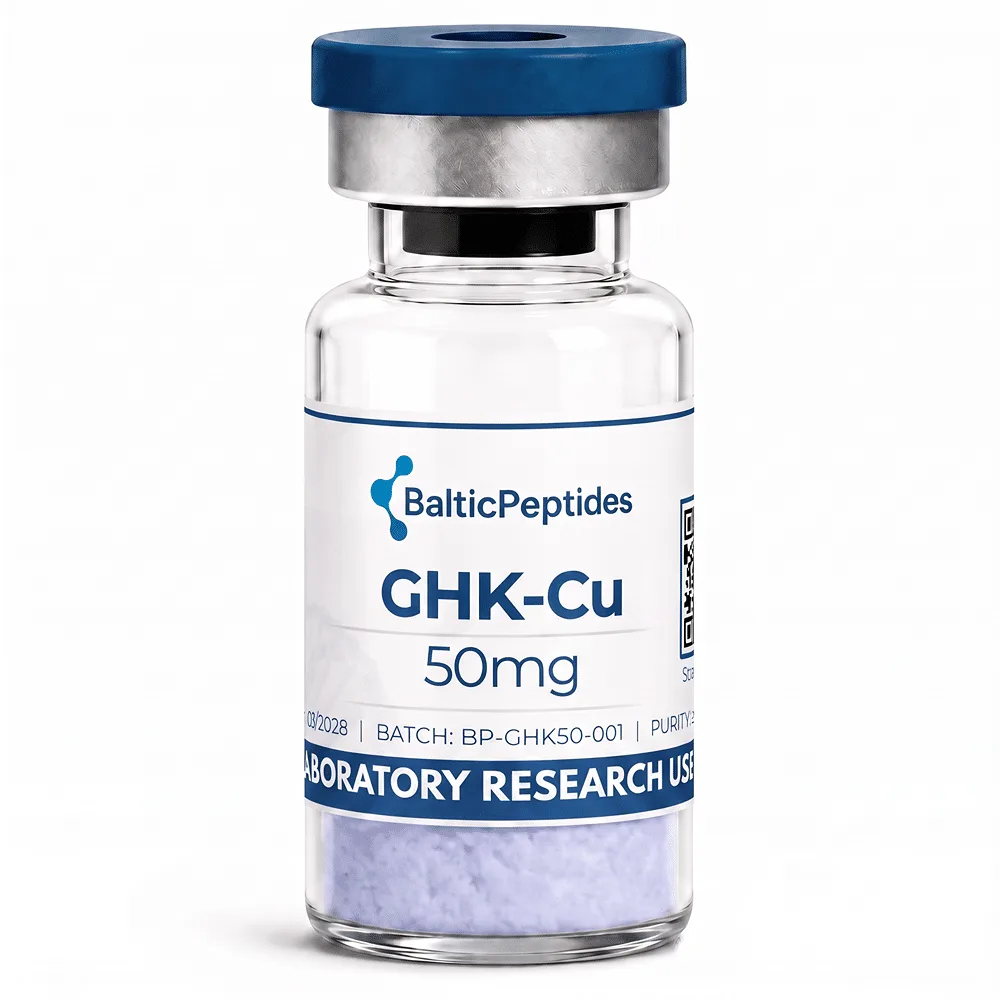
GHK-Cu
GLOW Blend (GHK-Cu + BPC-157 + TB-500)