TB-500 Research Guide 2026: Thymosin Beta-4 Repair
TB-500 is a seven-amino-acid synthetic peptide derived from the active region of the 43-residue protein Thymosin Beta-4 (Tβ4). The two names are often used interchangeably but are not identical: TB-500 corresponds to the actin-binding domain of full Tβ4 and is the form used in most preclinical wound-repair and cell-migration studies, while full Tβ4 has been investigated in registered clinical programs for dry eye and epidermolysis bullosa.
Native Tβ4 was isolated from calf thymus by Allan Goldstein and colleagues in 1981 and is among the most abundant intracellular peptides in mammalian cells, where it acts as the principal G-actin sequestering protein. The fragment retains the LKKTETQ actin-binding motif and reproduces the migratory, anti-inflammatory, and angiogenic effects of full Tβ4 in injury models. Which one you actually receive is worth checking before anything else. "TB-500" is a trade name, and suppliers use it for two different molecules: the short fragment described above, and the complete 43-residue Tβ4 protein. You do not need to interpret the name - the certificate settles it, because the two differ more than fivefold in mass. Full Tβ4 comes in around 4,960 g/mol; the fragment is under 900. The material we link to is the full-length protein.
This review summarizes the mechanistic literature, preclinical dosing, comparison with BPC-157, and the research-only status of the compound; see our research disclaimer.
What is TB-500?
TB-500 is a seven-amino-acid synthetic peptide corresponding to the central active region of Thymosin Beta-4, with the LKKTETQ actin-binding motif preserved. It is not the full Tβ4 protein: full Tβ4 is a 43-residue, 4.9 kDa peptide with additional N- and C-terminal regions contributing non-actin functions.
The LKKTETQ motif is sufficient to reproduce the G-actin sequestering behavior that defines the parent protein. For research use, TB-500 is supplied as a lyophilized powder, typically >=99% purity by HPLC; review batch-specific Certificates of Analysis before incorporating into a protocol. TB-500 is structurally distinct from BPC-157 and acts through entirely different molecular machinery despite frequent co-administration in stacking research.
Mechanism of Action
TB-500 exerts its effects through the actin cytoskeleton and a small set of downstream signaling axes. Unlike many growth factors, TB-500 does not bind a classical cell-surface receptor; its primary activity is intracellular sequestration of monomeric (G-) actin via the conserved LKKTETQ motif, with secondary effects on migration, inflammation, and angiogenesis.
Actin Sequestration and Cytoskeletal Regulation
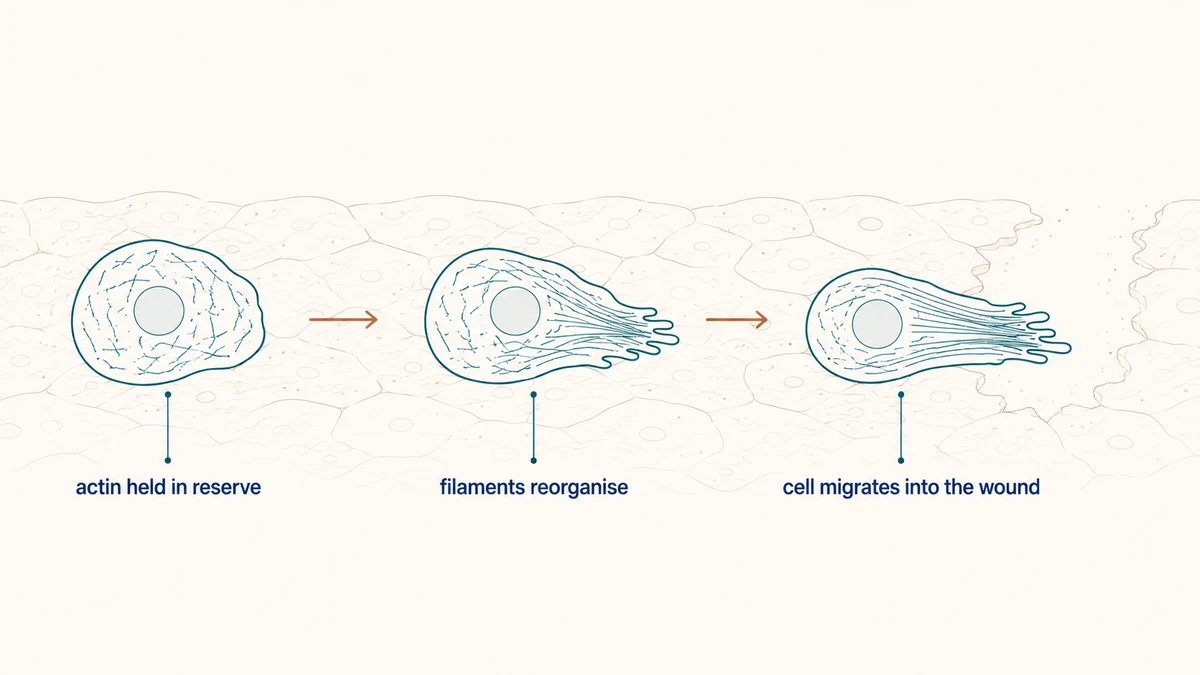
The defining biochemical activity of Tβ4 (and the TB-500 fragment) is 1:1 binding of monomeric G-actin through the LKKTETQ helix, preventing spontaneous polymerization into F-actin. By regulating the unpolymerized actin pool, TB-500 acts as a rheostat for cytoskeletal remodeling: on migration or repair signals, sequestered G-actin is released and polymerized at the leading edge. Kleinman and colleagues at the NIH established the structural basis of this interaction in the 1990s and showed the LKKTETQ peptide alone is sufficient for G-actin binding.
Cell Migration via the Tβ4-Actin Complex
By controlling cytoskeletal dynamics, TB-500 promotes directional migration of endothelial cells, keratinocytes, fibroblasts, and cardiac progenitors in scratch-wound and Boyden-chamber assays. This migratory effect is the most consistently reproduced functional outcome in the Tβ4 literature and underlies reported acceleration of dermal, corneal, and tendon repair. Sosne and colleagues documented this in corneal epithelial models, showing accelerated re-epithelialization after chemical and mechanical injury.
Anti-Inflammatory Effects via NF-κB
TB-500 / Tβ4 dampens inflammatory signaling in part via the NF-κB pathway. Sosne and colleagues showed that Tβ4 inhibits LPS-induced NF-κB activation in corneal epithelial cells, reducing transcription of TNF-α, IL-1β, and other cytokines - consistent with broader observations of reduced leukocyte infiltration in Tβ4-treated injury models.
Angiogenesis Enhancement
TB-500 promotes endothelial cell migration, tube formation, and capillary outgrowth in standard angiogenesis assays. The mechanism is distinct from BPC-157's VEGFR2-mediated pathway: Tβ4 acts intracellularly through actin remodeling that enables endothelial migration into the wound bed, with secondary upregulation of VEGF and laminin in some models. Bock-Marquette et al. (2004, Nature) reported Tβ4-driven cardiac progenitor migration and capillary formation in a mouse myocardial infarction model.
Pharmacokinetics and Half-Life
Pharmacokinetic data on TB-500 / Tβ4 is limited and largely derived from rodent studies and registered Tβ4 clinical programs. After subcutaneous (SC) or intramuscular (IM) administration in rats, TB-500 enters systemic circulation with a plasma half-life on the order of two to three hours - substantially longer than BPC-157 - followed by tissue redistribution. Tβ4 is unusual in being highly soluble, relatively protease-resistant, and naturally present at high intracellular concentrations.
Most published animal protocols use SC or IM injection at the loading phase. Tissue distribution favors sites of active injury and inflammation. No human pharmacokinetic data has been published for the fragment specifically; available human PK comes from full Tβ4 trials and should not be extrapolated directly to the fragment.
Comparative Research Dosage Reference
The table below summarizes published TB-500 / Tβ4 dose ranges across commonly cited preclinical models. These figures are drawn from peer-reviewed animal and in vitro research and are not human dosing recommendations.
| Model | Route | Dose Range | Reference |
|---|---|---|---|
| Rat Achilles tendon injury | IM | 150 µg/kg | Xu et al. 2018 |
| Mouse cardiac infarction | IP | 150 µg/dose | Bock-Marquette et al. 2004 |
| Rat corneal epithelial debridement | Topical | 0.1% (1 mg/mL) | Sosne et al. 2002 |
| Mouse skin wound healing | SC / topical | 5-50 µg/wound | Malinda et al. 1999 |
| Endothelial cell migration (in vitro) | Culture | 1-100 ng/mL | Grant et al. 1999 |
| Rat dermal wound | SC | 60-600 µg/kg | Philp et al. 2003 |
| Mouse hindlimb ischemia | IM | 150 µg/dose | Smart et al. 2007 |
Topical and locally injected delivery are well represented in this literature alongside systemic routes, reflecting Tβ4's dermal and corneal applications.
TB-500 vs BPC-157
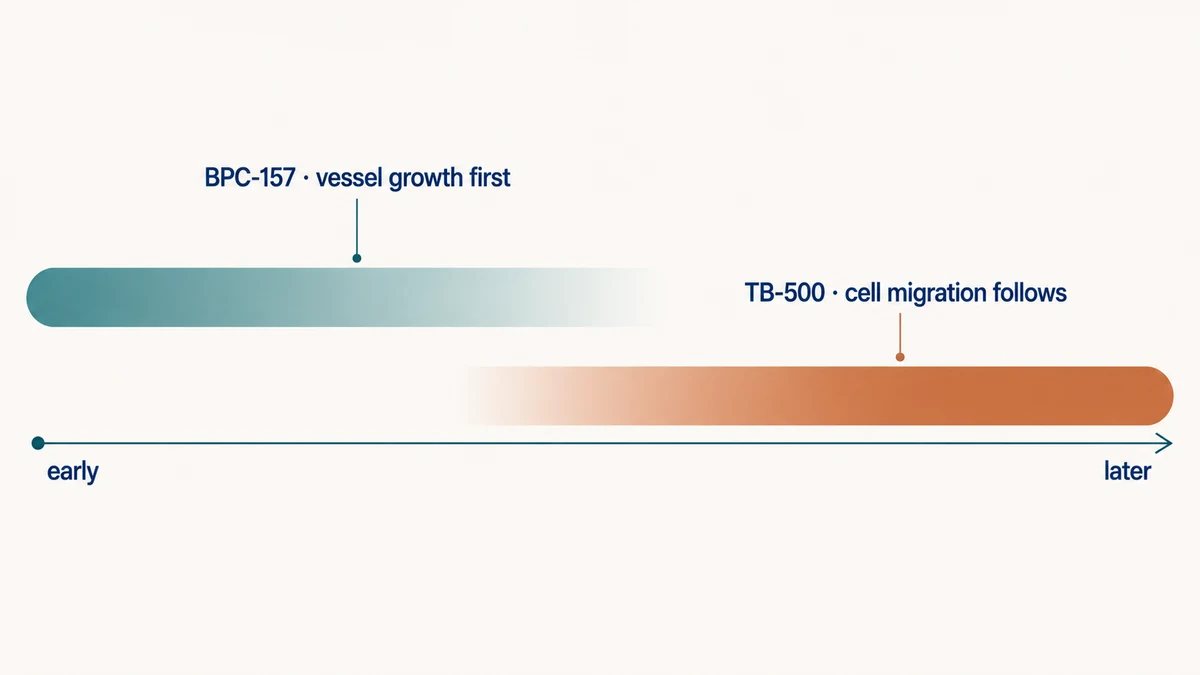
TB-500 and BPC-157 are frequently studied together because their mechanisms are complementary rather than overlapping. BPC-157 acts through extracellular and membrane-associated pathways (non-canonical VEGFR2 internalization, EGR-1 / FAK-paxillin signaling, bidirectional NO modulation). TB-500 acts intracellularly via G-actin sequestration and cytoskeletal remodeling that drives cell migration.
This difference motivates the most commonly studied stacking protocol in preclinical tendon and muscle models: BPC-157 accelerates revascularization and growth-factor signaling while TB-500 accelerates migration of fibroblasts, endothelial cells, and progenitors into the repair zone. For a detailed review of paired use, see our BPC-157 + TB-500 stacking protocol review. Head-to-head solo-vs-combined comparisons remain rare, and most stacking claims rest on mechanistic plausibility rather than direct trial data.
Safety, Limitations, and Research Gaps
TB-500's safety profile mirrors BPC-157's: acceptable in animal models, unestablished in humans for the fragment. No rodent study has reported acute toxicity at therapeutic doses, and full Tβ4 has progressed through phase II human trials for dry eye and dermal indications without serious safety signals. However, no controlled human trial has been published for the synthetic TB-500 fragment, which remains a research-use-only compound in every major regulatory jurisdiction.
TB-500 is on the WADA Prohibited List under class S2 (peptide hormones, growth factors, and mimetics) and is banned in competitive sport at all times - stated here as a factual regulatory matter. Open questions include long-term immunogenicity and the extent to which fragment data can be extrapolated from full Tβ4 studies. For storage guidance, see our peptide storage reference.
Conclusion
TB-500 is one of the better-characterized actin-binding peptides in preclinical research, with a clear mechanism (G-actin sequestration via LKKTETQ), reproducible cell-migration effects, and a profile complementary to BPC-157 that motivates ongoing stacking research. Its limitations are equally clear: it is a fragment rather than full Tβ4, controlled human trials of the fragment have not been published, and it is on the WADA prohibited list. TB-500 remains a useful research tool for studying cytoskeletal contributions to tissue repair within research-use boundaries - see our research disclaimer.
Source this peptide for your research
Order TB-500 at Baltic PeptidesResearch source
Source TB-500 for your research
Lab-tested, ≥99% HPLC purity. Certificate of Analysis available per batch.
View productFrequently Asked Questions
Is TB-500 legal to purchase and study?
TB-500 is sold worldwide as a research chemical for in vitro and animal-model use. It is not approved by the FDA or EMA for human use. It is also on the World Anti-Doping Agency (WADA) Prohibited List under class S2 and is banned in competitive sport at all times. Researchers should comply with local regulations governing peptide research and import.
What is the difference between TB-500 and Thymosin Beta-4?
Thymosin Beta-4 (Tβ4) is a 43-amino-acid naturally occurring intracellular protein. TB-500 is a seven-amino-acid synthetic fragment containing the central actin-binding motif (LKKTETQ) of Tβ4. The fragment reproduces the cytoskeletal and migratory effects of the parent protein in preclinical models but does not include all of its non-actin functions.
Is TB-500 orally active?
No reliable evidence supports oral activity of TB-500 in research models. Published preclinical protocols use subcutaneous, intramuscular, intraperitoneal, or topical administration. Unlike BPC-157, TB-500 is not characterized as resistant to gastric proteolysis, and oral bioavailability has not been demonstrated.
How long do TB-500 effects last after a single dose?
Plasma half-life in rats is approximately two to three hours after SC or IM administration, but downstream cytoskeletal and migratory effects on cells in the repair zone are observed for considerably longer. Most published animal protocols use weekly or twice-weekly dosing during the loading phase to maintain tissue exposure.
What purity standard should research-grade TB-500 meet?
Reputable research suppliers certify TB-500 at >=99% purity by HPLC, with identity confirmed by mass spectrometry on a per-batch basis. Always review the Certificate of Analysis for the specific lot before incorporating the peptide into a study protocol.
Is TB-500 commonly studied with BPC-157?
Yes. The two peptides are frequently combined in preclinical tendon, ligament, and muscle-repair models because their mechanisms are complementary: BPC-157 acts on VEGFR2-driven angiogenesis and EGR-1 / FAK-paxillin signaling, while TB-500 acts intracellularly via G-actin sequestration and migration. Controlled head-to-head solo vs combined comparisons are still rare in the literature.
Scientific References
- Goldstein AL, Hannappel E, Kleinman HK. Thymosin beta4: actin-sequestering protein moonlights to repair injured tissues. Trends Mol Med. 2005;11(9):421-429. PMID: 16099219[PubMed Reference]
- Bock-Marquette I, Saxena A, White MD, et al. Thymosin beta4 activates integrin-linked kinase and promotes cardiac cell migration, survival and cardiac repair. Nature. 2004;432(7016):466-472. PMID: 15565145[PubMed Reference]
- Sosne G, Qiu P, Goldstein AL, Wheater M. Biological activities of thymosin beta4 defined by active sites in short peptide sequences. FASEB J. 2010;24(7):2144-2151. PMID: 20179146[PubMed Reference]
- Sosne G, Christopherson PL, Barrett RP, Fridman R. Thymosin-beta4 modulates corneal matrix metalloproteinase levels and polymorphonuclear cell infiltration after alkali injury. Invest Ophthalmol Vis Sci. 2005;46(7):2388-2395. PMID: 15980226[PubMed Reference]
- Malinda KM, Sidhu GS, Mani H, et al. Thymosin beta4 accelerates wound healing. J Invest Dermatol. 1999;113(3):364-368. PMID: 10469335[PubMed Reference]
- Philp D, Badamchian M, Scheremeta B, et al. Thymosin beta 4 and a synthetic peptide containing its actin-binding domain promote dermal wound repair in db/db diabetic mice and in aged mice. Wound Repair Regen. 2003;11(1):19-24. PMID: 12581423[PubMed Reference]
- Grant DS, Rose W, Yaen C, et al. Thymosin beta4 enhances endothelial cell differentiation and angiogenesis. Angiogenesis. 1999;3(2):125-135. PMID: 14517430[PubMed Reference]
- Crockford D, Turjman N, Allan C, Angel J. Thymosin beta4: structure, function, and biological properties supporting current and future clinical applications. Ann N Y Acad Sci. 2010;1194:179-189. PMID: 20536467[PubMed Reference]
Related Research Peptides
TB-500
BPC-157