AOD-9604 Research Guide 2026: HGH 176-191 Fat Loss

AOD-9604 - Anti-Obesity Drug 9604 - is a synthetic 16-amino-acid peptide corresponding to the C-terminal 176-191 fragment of human growth hormone (hGH), with an additional N-terminal tyrosine residue added for stability. It was engineered to isolate the lipolytic (fat-mobilizing) activity of hGH from its growth-promoting and insulin-antagonizing effects, providing a research tool for dissecting which regions of the parent hormone drive specific metabolic outputs.
Unlike full recombinant hGH, AOD-9604 does not measurably elevate IGF-1, does not stimulate longitudinal bone growth, and does not affect carbohydrate metabolism in the standard published preclinical models. This dissociation between fat-mobilizing and growth-axis effects is the central mechanistic claim that motivated its development at Monash University and its subsequent translation through Phase II clinical research at Metabolic Pharmaceuticals. AOD-9604 is provided strictly for in vitro and animal research; see our research disclaimer.
What is AOD-9604?
AOD-9604 is a 16-amino-acid synthetic peptide derived from residues 176-191 of the human growth hormone C-terminus, with the addition of an N-terminal tyrosine residue to improve stability and analytical detection. The peptide retains the hexadecapeptide motif that Frank Ng and colleagues at Monash University identified as the minimal lipolytic-active region of hGH, work that built on Ng's 1986 mapping of the C-terminal lipolytic domain.
Structural derivation from hGH gives AOD-9604 a clear mechanistic logic: the parent hormone is a 191-amino-acid protein with separable functional domains, and Ng's group showed that the fat-mobilizing activity localizes to the 177-191 region while the growth-promoting and diabetogenic activities require other parts of the molecule. AOD-9604 is supplied as a lyophilized powder, typically certified at >=99% purity by HPLC; researchers should review the Certificate of Analysis before incorporating the compound into a study protocol.
Mechanism of Action
AOD-9604 acts on adipose tissue through a mechanism distinct from classical β-adrenergic lipolysis, although it converges on similar downstream lipid-mobilization endpoints. The published mechanistic model emphasizes selective lipolysis without growth-axis activation.
Lipolysis and a β3-Adrenergic-Like Profile
In rodent adipocyte studies, AOD-9604 stimulates lipolysis and free fatty acid release with a profile that resembles β3-adrenergic agonism - increased intracellular cAMP in adipocytes, hormone-sensitive lipase activation, and net triglyceride breakdown. Heffernan and colleagues (2000, Endocrine Research) reported dose-dependent fat oxidation and energy expenditure increases in obese mice receiving the 177-191 fragment, with effects blocked by β3-receptor inhibitors in some assays. The exact receptor interaction remains unresolved: AOD-9604 is not a high-affinity β3 ligand, and its activity is better described as functionally β3-adrenergic-like rather than receptor-identical.
Absence of Growth-Promoting Effects
The defining feature of AOD-9604 in the published literature is the absence of IGF-1 elevation and bone-growth stimulation. Heffernan, Ng and colleagues (2001, Journal of Endocrinology) directly compared AOD-9604 with full hGH in obese mouse models and showed that the fragment reproduced fat-mobilizing effects without measurable changes in serum IGF-1, insulin sensitivity, or longitudinal growth markers. This dissociation is the core rationale for developing the fragment as a research tool - and later, briefly, as a clinical anti-obesity candidate - separate from full hGH.
CB1 Receptor Implication and Cartilage Studies
Later work expanded the mechanistic picture. Studies in chondrocyte cultures suggested AOD-9604 may interact with components of the endocannabinoid CB1 receptor system in cartilage, with reports of pro-anabolic effects on chondrocyte matrix synthesis in osteoarthritis-model investigations. These findings remain less reproduced than the core lipolytic data and are best treated as hypothesis-generating; they do, however, motivate ongoing interest in AOD-9604 outside the strict fat-metabolism context.
Recent Research Timeline (2010-2025)
The AOD-9604 literature is concentrated in the 2000s with the Monash and Metabolic Pharmaceuticals programs, followed by sporadic mechanistic work in the 2010s and 2020s.
Ng FM, Bornstein J. (1986) - The original mapping paper from the Monash group identifying the C-terminal lipolytic domain of hGH and laying the groundwork for fragment 177-191 development.
*Heffernan M, Summers RJ, Thorburn A, et al. (2000), Endocrine Research*** - Fat oxidation and energy-expenditure data for the hGH 177-191 fragment in obese mice, with comparison to full hGH and β3-agonist controls.
*Heffernan MA, Jiang WJ, Thorburn AW, Ng FM. (2001), Journal of Endocrinology*** - Direct demonstration that the 177-191 fragment reproduces hGH lipolytic activity without IGF-1 elevation or insulin antagonism in ob/ob mice. Often cited as the foundational AOD-9604 mechanistic paper.
Metabolic Pharmaceuticals Phase II clinical program (2004-2007) - Phase IIa and IIb obesity trials in human volunteers in Australia. Results showed modest fat-loss signals and an acceptable acute safety profile but did not meet the primary endpoints required for advancement; the program was discontinued.
Kim YS, Lee YM, Oh TI, et al. (2014-2020s) - Korean groups have published in vitro and animal studies on AOD-9604 effects in chondrocytes and osteoarthritis models, expanding the mechanistic discussion beyond pure adipose-tissue lipolysis.
Safety, Limitations, and Regulatory Status
AOD-9604 has no human therapeutic approval in any jurisdiction. The Phase IIb obesity trials run by Metabolic Pharmaceuticals were completed but did not progress to Phase III, and the development program was discontinued. The compound was subsequently designated by the Australian Therapeutic Goods Administration (TGA) as a substance that may be used in complementary medicine contexts under specific conditions, though it is not registered as a therapeutic drug.
In the published clinical record, AOD-9604 was generally well tolerated at the doses studied, with no signal of IGF-1 elevation, insulin resistance, or growth-axis disturbance - consistent with its preclinical profile. However, the trials were short (weeks to a few months), the sample sizes were modest, and long-term human safety data does not exist. The compound remains a research-use-only peptide outside of regulated TGA contexts. Researchers should design protocols around acute or sub-chronic exposure and review the Certificate of Analysis for the working lot before use.
Conclusion
AOD-9604 occupies a clear niche in metabolic peptide research: a structurally rational fragment of hGH that isolates lipolytic activity from growth-axis stimulation, with foundational mechanistic work from the Ng and Heffernan groups and a completed-but-discontinued clinical record. It is a useful tool for studying fat-mobilization mechanisms in animal and adipocyte models, but it is not an approved human therapeutic and should be handled strictly within research-use boundaries - see our research disclaimer and storage reference.
Source this peptide for your research
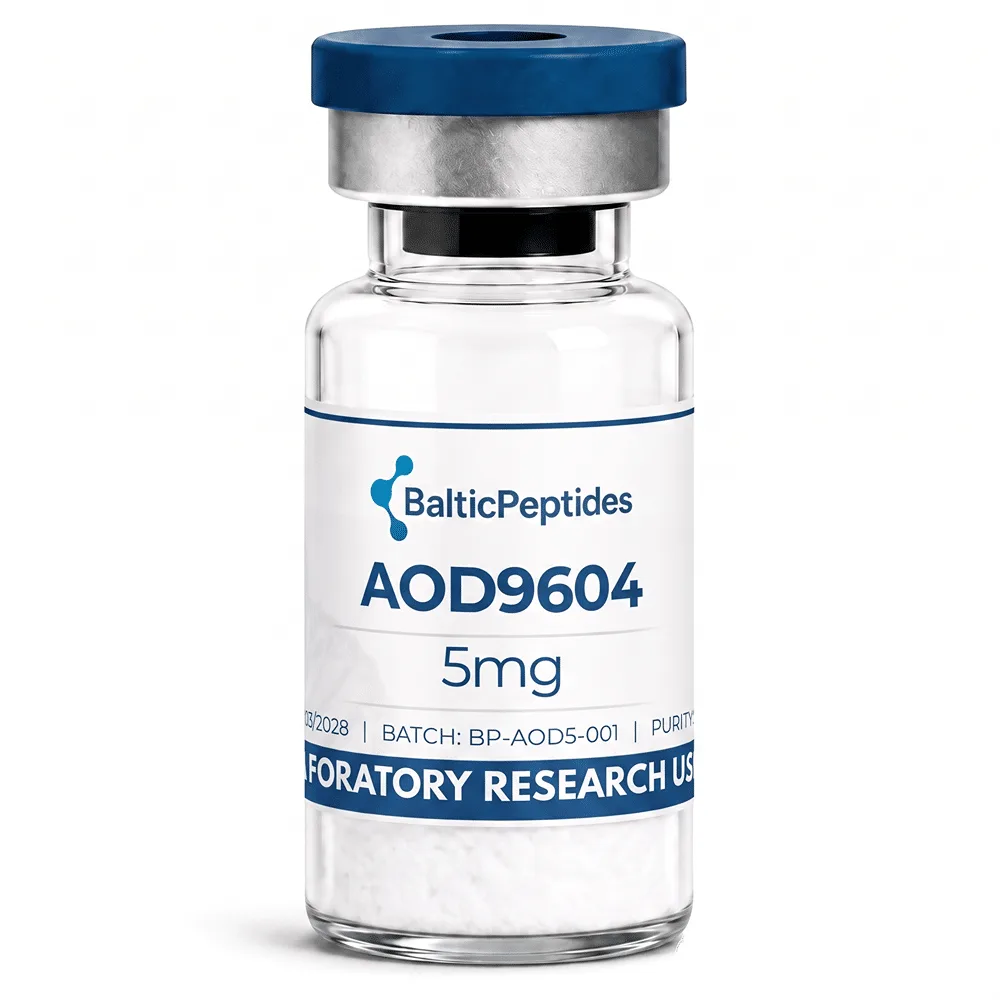
Order AOD9604 at Baltic PeptidesResearch source
Source AOD9604 for your research
Lab-tested, ≥99% HPLC purity. Certificate of Analysis available per batch.
View productFrequently Asked Questions
Is AOD-9604 legal to purchase and study?
AOD-9604 is sold worldwide as a research chemical for in vitro and animal-model use. It is not approved as a therapeutic drug by the FDA or EMA. In Australia, the TGA has permitted its use under specific complementary-medicine conditions but it is not a registered therapeutic. Researchers should comply with local regulations governing peptide research and import.
How does AOD-9604 differ from full human growth hormone?
AOD-9604 corresponds only to the C-terminal 176-191 region of hGH plus an N-terminal tyrosine. It reproduces hGH's lipolytic activity in animal models but does not elevate IGF-1, does not stimulate longitudinal bone growth, and does not antagonize insulin action - the dissociation that motivated its development as a fat-metabolism research tool.
Is AOD-9604 orally active?
Heffernan et al. (2000) reported lipolytic effects of an oral preparation of the hGH 177-191 fragment in obese mice, and the Metabolic Pharmaceuticals clinical program included oral formulations. However, most preclinical research uses subcutaneous injection for dose precision, and oral bioavailability has not been characterized as robustly as it has for peptides like BPC-157.
What is the half-life of AOD-9604?
Published pharmacokinetic data are limited. After subcutaneous administration in animal models the plasma half-life is on the order of tens of minutes, with biological effects on lipolysis observed for several hours. Human PK data from the Metabolic Pharmaceuticals trials were not extensively published in the peer-reviewed literature.
Where can researchers obtain research-grade AOD-9604?
Reputable research suppliers certify AOD-9604 at >=99% purity by HPLC with mass-spec identity confirmation on a per-batch basis. Always review the Certificate of Analysis for the specific lot before incorporating the peptide into a study protocol.
Scientific References
- Ng FM, Bornstein J. Hyperglycaemic action of synthetic C-terminal fragments of human growth hormone. Acta Endocrinol (Copenh). 1986;112(2):213-218
- Heffernan M, Summers RJ, Thorburn A, et al. The effects of human GH and its lipolytic fragment (AOD9604) on lipid metabolism following chronic treatment in obese mice and beta(3)-AR knock-out mice. Endocrinology. 2001;142(12):5182-5189. PMID: 11713213[PubMed Reference]
- Heffernan MA, Jiang WJ, Thorburn AW, Ng FM. Effects of oral administration of a synthetic fragment of human growth hormone on lipid metabolism. Am J Physiol Endocrinol Metab. 2000;279(3):E501-E507. PMID: 10950816[PubMed Reference]
- Ng FM, Sun J, Sharma L, et al. Metabolic studies of a synthetic lipolytic domain (AOD9604) of human growth hormone. Horm Res. 2000;53(6):274-278. PMID: 11146367[PubMed Reference]
- Stier H, Vos E, Kenley D. Safety and tolerability of the hexadecapeptide AOD9604 in humans. J Endocrinol Metab. 2013;3(1-2):7-15.
- Kim MJ, Kim SC, Chung S, et al. Suppression of pro-inflammatory cytokine and matrix metalloproteinase expression by AOD9604 in chondrocytes. Mol Med Rep. 2019;19(3):2316-2322
Related Research Peptides
AOD9604
Tirzepatide