Tirzepatide vs Semaglutide vs Retatrutide
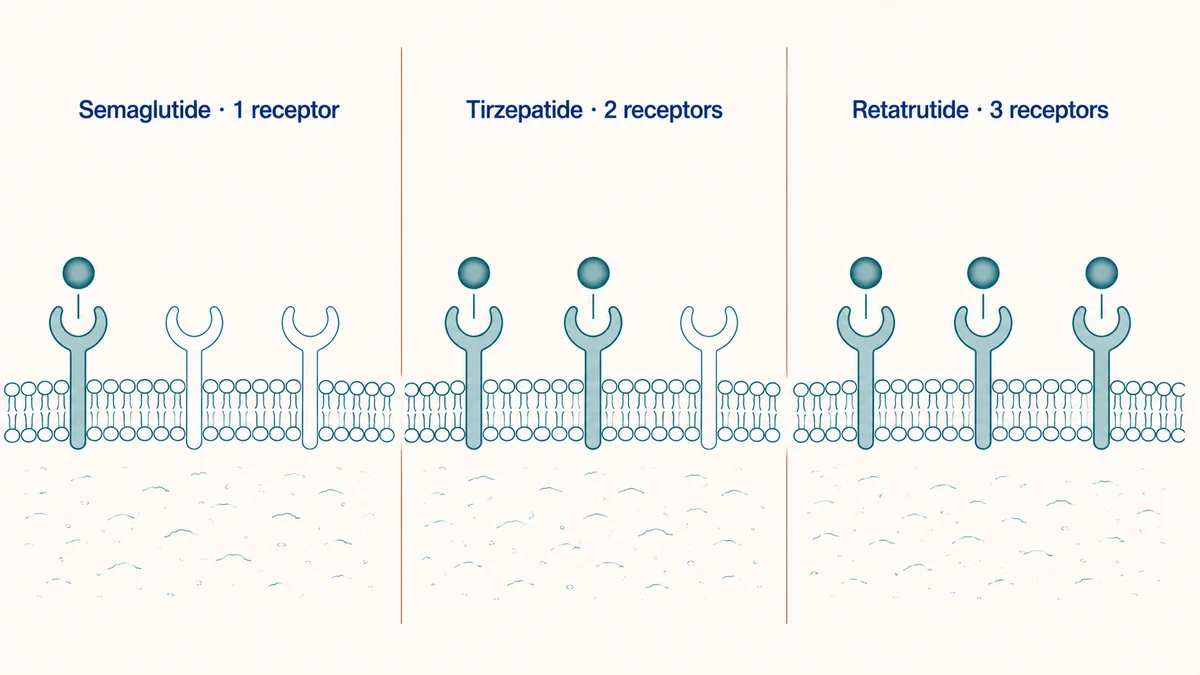
Semaglutide, Tirzepatide, and Retatrutide represent three sequential rounds of incretin-receptor agonist research, each developed by major pharmaceutical research groups and each pursuing a different design philosophy. Semaglutide (Novo Nordisk) is a mono-agonist of the GLP-1 receptor, first approved in 2017 under the brand Ozempic for diabetes research-clinical use, and later as Wegovy in 2021. Tirzepatide (Eli Lilly) is a dual agonist engaging both the GIP and GLP-1 receptors, approved in 2022 as Mounjaro and subsequently as Zepbound. Retatrutide (Eli Lilly) is a triple agonist of GLP-1, GIP, and the glucagon receptor, in Phase 3 trials as of 2024 and not approved for any human therapeutic indication.
This article frames the three compounds strictly as scientific milestones in incretin pharmacology. They are most usefully understood not as competing products but as a research-design progression: each successive molecule added a receptor target to study additive effects on incretin biology. The published trial literature - SUSTAIN and STEP series for semaglutide, SURPASS series for tirzepatide, and TRIUMPH series for retatrutide - provides the factual basis for any comparison.
Nothing in this article constitutes a recommendation for human use of any of these compounds. All three are pharmaceutical-regulated entities outside research contexts. The discussion below is research history and mechanism only. Researchers seeking a research-grade triple-agonist analog for in vitro and animal-model work may consult the GLP-3 product page; see also our research disclaimer.
Quick Comparison Table
The table below summarizes the principal published characteristics of the three compounds. All values are reproduced from peer-reviewed pharmacology literature and registered clinical-trial publications, not from product marketing material.
| Attribute | Semaglutide | Tirzepatide | Retatrutide |
|---|---|---|---|
| Manufacturer (research) | Novo Nordisk | Eli Lilly | Eli Lilly |
| Receptor targets | GLP-1 | GIP + GLP-1 | GLP-1 + GIP + glucagon |
| First approved (clinical) | 2017 (Ozempic) | 2022 (Mounjaro) | Phase 3 (not approved) |
| Plasma half-life | ~7 days | ~5 days | ~6 days (Phase 1 estimate) |
| Brand names | Ozempic / Wegovy / Rybelsus | Mounjaro / Zepbound | (research only) |
| Pivotal trial program | SUSTAIN, STEP | SURPASS, SURMOUNT | TRIUMPH |
All three compounds are subcutaneous injectables in their registered or trialed forms (semaglutide additionally has an oral formulation, Rybelsus). The table is a factual research summary; expanded mechanism, pharmacokinetic, and trial detail follows in the sections below.
Mechanism: Three Approaches to Incretin Signaling
The mechanistic distinction across the three compounds is straightforward - each adds a receptor target to the previous design. The subsections below summarize each receptor-binding profile and the published rationale for adding each target. All mechanism descriptions are drawn from peer-reviewed pharmacology literature.
Mono-agonism: GLP-1 only (Semaglutide)
Semaglutide is a 31-amino-acid analog of native glucagon-like peptide-1 (GLP-1), with two amino acid substitutions (Aib at position 8, Arg at position 34) and a C18 fatty diacid attached via a glutamic acid spacer to lysine-26. The fatty acid modification confers reversible albumin binding, which extends plasma half-life and confers DPP-IV resistance. Semaglutide selectively activates the GLP-1 receptor (GLP-1R) - a class B Gαs-coupled receptor expressed on pancreatic β-cells, hypothalamic neurons, and the gastrointestinal tract - and elicits classical GLP-1R signaling: cAMP elevation, PKA and EPAC2 activation, glucose-dependent insulin secretion, glucagon suppression in hyperglycemic states, and delayed gastric emptying. The mechanism was characterized extensively by Lau and colleagues at Novo Nordisk (Lau et al. 2015, J Med Chem).
Dual agonism: GLP-1 + GIP (Tirzepatide)
Tirzepatide is a 39-amino-acid synthetic peptide engineered by Eli Lilly that combines structural elements of native glucose-dependent insulinotropic polypeptide (GIP) with GLP-1-like substitutions, plus a C20 fatty diacid for albumin binding. Tirzepatide is described by Coskun et al. (2018, Mol Metab) as a 'dual GIP and GLP-1 receptor agonist', with imbalanced potency - somewhat higher activity at GIP-R than GLP-1R in cell-based assays. The historical research rationale for adding GIP agonism, articulated in the Coskun mechanism paper and earlier dual-agonist literature (Finan et al. 2013, Sci Transl Med), is that GIP and GLP-1 activate distinct β-cell signaling pathways with potentially additive insulinotropic effects, and that GIP signaling on adipocytes may complement GLP-1's central appetite effects in published metabolic models.
Triple agonism: GLP-1 + GIP + glucagon (Retatrutide)
Retatrutide (LY3437943) is a 39-residue synthetic peptide adding glucagon receptor agonism to the GIP/GLP-1 dual profile. The compound's published mechanism, characterized by Coskun, Knerr, and colleagues (Knerr et al. 2022, J Med Chem; Coskun et al. 2022, Cell Metab), shows balanced agonism at all three receptors with EC50 values within an order of magnitude across the three. The published research rationale for adding glucagon agonism is the historical observation that glucagon receptor activation increases hepatic energy expenditure and lipolysis in animal models (Day et al. 2009, Nat Chem Biol). Combining glucagon agonism with GLP-1 agonism - which suppresses glucagon's hyperglycemic effects via insulinotropic action - was theorized to dissociate glucagon's metabolic from glycemic effects in research-model contexts.
Synthesis: A Research-Design Progression
The three compounds are best understood as successive iterations on a single research question: how does adding incretin and related receptor targets affect the integrated signaling of the entero-pancreatic-hypothalamic axis? Each generation adds a receptor; each phase of trials provided published efficacy and safety data that informed the next design. The research literature does not yet resolve whether the additive receptor strategy continues to scale beyond triple agonism, and longer-term mechanistic questions - receptor desensitization, pathway crosstalk, tissue-selective signaling - remain open. Researchers studying multi-receptor agonism in vitro may find a research-grade triple-agonist comparator useful; see GLP-3 for the analog Particle Peptides supplies for that purpose.
Pharmacokinetics & Half-Life Comparison
All three compounds rely on fatty-acid-mediated albumin binding to extend plasma exposure beyond the minutes-scale half-life of native GLP-1 (~2 minutes) and native GIP (~5-7 minutes). The specific PK profiles, drawn from registered Phase 1 and Phase 2 publications, differ as follows.
Semaglutide has a plasma half-life of approximately 7 days in human research studies, supporting once-weekly subcutaneous dosing in registered protocols (Lau et al. 2015; Marbury et al. 2017). The C18 diacid linker confers strong but reversible albumin binding (>99%), and clearance is primarily via proteolytic degradation rather than renal excretion. The oral formulation (Rybelsus) uses an SNAC absorption enhancer to overcome gastric peptide degradation; oral bioavailability is approximately 1%, but daily dosing compensates.
Tirzepatide has a plasma half-life of approximately 5 days in human research studies (Urva et al. 2022, Clin Pharmacokinet), also supporting once-weekly subcutaneous administration. The C20 diacid imparts albumin binding similar in magnitude to semaglutide's, and disposition is similarly proteolytic. No oral formulation has been disclosed in the registered literature.
Retatrutide Phase 1 PK data, reported by Urva et al. (2022, Lancet) and Coskun et al. (2022, Cell Metab), describe a plasma half-life of approximately 6 days with dose-proportional exposure and once-weekly subcutaneous suitability. The PK profile is consistent with the design intent of matching the dosing cadence of earlier-generation incretin agonists. Final approved-label PK figures will follow Phase 3 completion.
The convergent ~5-7 day half-life across all three compounds reflects shared design constraints - albumin binding strong enough to extend exposure across a week, but reversible enough to permit clearance - rather than receptor pharmacology per se.
Published Research Timeline
The published research history of incretin-receptor agonism spans approximately four decades. The milestones below are factual records drawn from the peer-reviewed literature.
- 1980s-1990s: GLP-1 isolated and characterized as an incretin hormone; foundational mechanism work by Holst, Drucker, and colleagues (Drucker & Nauck 2006, Lancet - review). Native GLP-1 found insulinotropic but rapidly degraded by DPP-IV.
- 2005: Exenatide approved by the FDA as the first GLP-1 receptor agonist for clinical use, derived from exendin-4 originally isolated from Gila monster venom.
- 2010: Liraglutide approved - first daily-dosed mammalian-GLP-1-derived analog with fatty-acid albumin-binding.
- 2015: Lau et al. publish the medicinal chemistry of semaglutide in J Med Chem, establishing the once-weekly fatty-diacid platform.
- 2017: Semaglutide approved by the FDA as Ozempic for type 2 diabetes research-clinical use, following the SUSTAIN trial program.
- 2018: Coskun et al. publish the dual GIP/GLP-1 agonist mechanism of tirzepatide in Mol Metab.
- 2021: Wegovy (semaglutide 2.4 mg) approved following the STEP trial program. Wilding et al. (2021, NEJM) report STEP-1 results.
- 2021: Frias et al. (2021, NEJM) report SURPASS-2 head-to-head results for tirzepatide vs. semaglutide.
- 2022: Tirzepatide approved by the FDA as Mounjaro, following the SURPASS trial program. Jastreboff et al. (2022, NEJM) report SURMOUNT-1 results.
- 2022: Knerr et al. (J Med Chem) and Coskun et al. (Cell Metab) publish retatrutide medicinal chemistry and triple-agonist mechanism.
- 2023: Jastreboff et al. publish retatrutide Phase 2 results in NEJM, marking the first large-scale triple-agonist data in the published literature.
- 2024: Retatrutide TRIUMPH Phase 3 program ongoing; not approved for any indication.
Each milestone reflects a published research event, not a commercial endorsement.
Comparative Research Efficacy in Published Trials
The three compounds have been studied in distinct registered trial programs. The published numerical findings below are reproduced as factual research outcomes - not as recommendations and not as comparative claims about relative product utility.
Semaglutide STEP program: Wilding et al. (STEP-1, 2021, NEJM) reported a mean body weight reduction of approximately 14.9% from baseline at 68 weeks at the 2.4 mg weekly subcutaneous dose, vs. 2.4% with placebo, in adults without diabetes. Earlier SUSTAIN program publications (Marso et al. 2016; Sorli et al. 2017) provided the diabetes-research efficacy baseline.
Tirzepatide SURPASS / SURMOUNT programs: Jastreboff et al. (SURMOUNT-1, 2022, NEJM) reported mean body weight reductions of approximately 15.0%, 19.5%, and 20.9% at the 5, 10, and 15 mg weekly doses respectively, over 72 weeks. SURPASS-2 (Frias et al. 2021, NEJM) showed greater HbA1c reduction with tirzepatide vs. semaglutide 1 mg.
Retatrutide TRIUMPH-2 / Phase 2: Jastreboff et al. (2023, NEJM) reported mean body weight reductions of approximately 17.5% and 24.2% at the 8 mg and 12 mg weekly doses respectively, over 48 weeks of Phase 2 data. Phase 3 data are not yet published.
The convergent observation across the three programs is dose- and receptor-dependent escalation of metabolic effect, consistent with the additive receptor-design hypothesis. Direct head-to-head comparisons between tirzepatide and retatrutide have not been published; cross-trial comparisons must be interpreted with caution given differences in trial duration, population, and protocol.
Safety Profiles in Published Research Literature
Across the three trial programs, the most frequently reported adverse events are gastrointestinal - nausea, vomiting, diarrhea, and constipation - with frequency increasing with dose escalation. The class-typical pattern is consistent with delayed gastric emptying and central GLP-1 receptor activation in the area postrema. In the SURPASS, STEP, SURMOUNT, and TRIUMPH publications, GI adverse events typically peak during titration and decline with sustained dosing.
Pancreatitis monitoring is a class-wide regulatory expectation for incretin-receptor agonists and is reported in each trial program. Across the published literature, pancreatitis incidence in trials has been low and not clearly elevated above placebo, but ongoing pharmacovigilance continues.
Thyroid C-cell effects observed in rodent models of GLP-1R agonist administration - medullary thyroid carcinoma in rats - have not been replicated in primate or human studies and are class-labeled as a precaution. Coskun, Knerr, and colleagues note in the retatrutide mechanism papers that the same class consideration applies to the triple agonist.
This is a factual safety summary drawn from registered trial publications. It is not clinical guidance.
For Research Peptide Users
Researchers studying GLP-1 family signaling in vitro or in animal models do not typically have access to the registered pharmaceutical preparations of semaglutide, tirzepatide, or retatrutide for general research procurement, and those compounds carry pharmaceutical-regulatory status outside their approved indications.
For research-grade work investigating triple-receptor agonism specifically, Particle Peptides supplies [GLP-3](/product/glp-3) - a research-grade triple-agonist analog suited to in vitro receptor-binding assays, cell-line signaling experiments, and rodent metabolic models. GLP-3 is supplied as a lyophilized peptide with batch-level lab reports and is intended strictly for in vitro and animal-model research.
Research-grade peptides are not pharmaceutical products and are not for human use. See our research disclaimer for the complete framing.
Conclusion
Semaglutide, tirzepatide, and retatrutide are three sequential rounds of incretin-receptor agonist research, each adding a receptor target to the previous design. The published mechanism, pharmacokinetic, and trial literature documents a scientifically coherent progression - from mono-agonism (GLP-1) to dual agonism (GIP + GLP-1) to triple agonism (GLP-1 + GIP + glucagon) - that has informed the broader incretin research field over the past decade. The three compounds are best understood as research-history milestones, not as interchangeable products or as competing weight-loss tools.
For research-context investigation of triple-agonist signaling in vitro or in animal models, GLP-3 is the research-grade analog Particle Peptides supplies for that purpose. None of the three pharmaceutical compounds discussed above - and no research-grade analog - is intended for human use outside registered clinical research. See our research disclaimer and the published references below for the underlying primary literature.
Source this peptide for your research
Order Tirzepatide at Baltic PeptidesResearch source
Source GLP-3 for your research
Lab-tested, ≥99% HPLC purity. Certificate of Analysis available per batch.
View productFrequently Asked Questions
What is the structural difference between Tirzepatide and Semaglutide?
Semaglutide is a 31-amino-acid GLP-1 analog with a C18 fatty-diacid albumin-binding modification, derived from native human GLP-1. Tirzepatide is a 39-amino-acid engineered peptide combining structural features of native GIP with GLP-1-like substitutions and a C20 fatty-diacid linker. Tirzepatide binds and activates both the GIP and GLP-1 receptors, while semaglutide is selective for GLP-1R. The two are different molecules engineered by different research groups.
Is Retatrutide approved for human use?
No. As of 2024, retatrutide is in Phase 3 clinical trials (the TRIUMPH program) and is not approved by the FDA, EMA, or any other regulator for any indication. Phase 2 data have been published in NEJM (Jastreboff et al. 2023). Approval, if it occurs, will follow Phase 3 completion and regulatory review. Retatrutide is not available as a registered pharmaceutical product.
Can these compounds be used interchangeably in research models?
No - they have different receptor-binding profiles and would be expected to produce different downstream signaling in any model that distinguishes GLP-1, GIP, and glucagon receptor activation. For research questions about a specific receptor pathway, the appropriate selective tool should be used. For questions about multi-receptor agonism, comparative studies typically use multiple compounds with characterized receptor profiles rather than substituting one for another.
How does GLP-3 (Particle Peptides research compound) compare to these clinical compounds?
GLP-3 is a research-grade triple-receptor agonist analog supplied for in vitro and animal-model investigation of GLP-1 / GIP / glucagon receptor signaling. It is designed for research use only - it is not a pharmaceutical product and is not a substitute for any registered clinical compound. Researchers studying triple-agonist mechanism in cell-line or rodent contexts may find GLP-3 useful as a research-grade comparator. See the GLP-3 product page and lab reports for batch-level analytical data.
Why did researchers add GIP receptor activity to GLP-1?
The published research rationale, articulated in the Coskun et al. (2018) and Finan et al. (2013) mechanism papers, is that GIP and GLP-1 activate distinct β-cell signaling pathways with potentially additive insulinotropic effects, and that GIP signaling on adipocytes may complement GLP-1's central appetite-regulatory effects in metabolic models. Adding GIP agonism produced measurable additive effects in published preclinical and clinical trial data, which informed the design of tirzepatide.
Why did Retatrutide add glucagon receptor activity?
The published rationale, drawn from Day et al. (2009) and the Knerr / Coskun mechanism papers, is that glucagon receptor activation increases hepatic energy expenditure and lipolysis in animal models, and that combining glucagon agonism with GLP-1 agonism - which suppresses glucagon's hyperglycemic effects via insulinotropic action - was theorized to dissociate glucagon's metabolic from glycemic effects in research-model contexts. The triple-agonist design tests that hypothesis directly.
Are any of these compounds available as research peptides from Baltic BioLabs?
Baltic BioLabs supplies GLP-3, a research-grade triple-agonist analog, for in vitro and animal-model research. Baltic BioLabs does not market the registered pharmaceutical compounds (semaglutide, tirzepatide, or retatrutide) and does not supply any of these compounds for human use. All research-grade peptides are supplied with batch-level lab reports and are intended strictly for non-clinical research. See our research disclaimer for the complete framing.
Scientific References
- Drucker DJ, Nauck MA. The incretin system: glucagon-like peptide-1 receptor agonists and dipeptidyl peptidase-4 inhibitors in type 2 diabetes. Lancet. 2006;368(9548):1696-1705. PMID: 17098089[PubMed Reference]
- Holst JJ. The physiology of glucagon-like peptide 1. Physiol Rev. 2007;87(4):1409-1439. PMID: 17928588[PubMed Reference]
- Lau J, Bloch P, Schaffer L, et al. Discovery of the once-weekly glucagon-like peptide-1 (GLP-1) analogue semaglutide. J Med Chem. 2015;58(18):7370-7380. PMID: 26308095[PubMed Reference]
- Marso SP, Bain SC, Consoli A, et al. Semaglutide and cardiovascular outcomes in patients with type 2 diabetes. N Engl J Med. 2016;375(19):1834-1844. PMID: 27633186[PubMed Reference]
- Wilding JPH, Batterham RL, Calanna S, et al. Once-weekly semaglutide in adults with overweight or obesity (STEP-1). N Engl J Med. 2021;384(11):989-1002. PMID: 33567185[PubMed Reference]
- Coskun T, Sloop KW, Loghin C, et al. LY3298176, a novel dual GIP and GLP-1 receptor agonist for the treatment of type 2 diabetes mellitus: from discovery to clinical proof of concept. Mol Metab. 2018;18:3-14. PMID: 30473097[PubMed Reference]
- Frias JP, Davies MJ, Rosenstock J, et al. Tirzepatide versus semaglutide once weekly in patients with type 2 diabetes (SURPASS-2). N Engl J Med. 2021;385(6):503-515. PMID: 34170647[PubMed Reference]
- Jastreboff AM, Aronne LJ, Ahmad NN, et al. Tirzepatide once weekly for the treatment of obesity (SURMOUNT-1). N Engl J Med. 2022;387(3):205-216. PMID: 35658024[PubMed Reference]
- Urva S, Coskun T, Loh MT, et al. LY3437943, a novel triple GIP, GLP-1 and glucagon receptor agonist in people with type 2 diabetes: a phase 1b, multicentre, double-blind, placebo-controlled, randomised, multiple-ascending dose trial. Lancet. 2022;400(10366):1869-1881. PMID: 36354040[PubMed Reference]
- Coskun T, Urva S, Roell WC, et al. LY3437943, a novel triple glucagon, GIP, and GLP-1 receptor agonist for glycemic control and weight loss: from discovery to clinical proof of concept. Cell Metab. 2022;34(9):1234-1247. PMID: 35985340[PubMed Reference]
- Knerr PJ, Mowery SA, Douros JD, et al. Next generation GLP-1/GIP/glucagon triple agonists normalize body weight in obese mice. Mol Metab. 2022;63:101533. PMID: 35809773[PubMed Reference]
- Jastreboff AM, Kaplan LM, Frias JP, et al. Triple-hormone-receptor agonist retatrutide for obesity - a phase 2 trial. N Engl J Med. 2023;389(6):514-526. PMID: 37366315[PubMed Reference]
- Day JW, Ottaway N, Patterson JT, et al. A new glucagon and GLP-1 co-agonist eliminates obesity in rodents. Nat Chem Biol. 2009;5(10):749-757. PMID: 19597507[PubMed Reference]
- Finan B, Yang B, Ottaway N, et al. A rationally designed monomeric peptide triagonist corrects obesity and diabetes in rodents. Nat Med. 2015;21(1):27-36. PMID: 25485909[PubMed Reference]
Related Research Peptides
Retatrutide
Tirzepatide