Bacteriostatic Water: The Reconstitution Reference
Every lyophilized peptide has to be dissolved before it can be used, and the choice of solvent is the most-repeated and least-examined decision in peptide handling. Bacteriostatic water is the default for a specific technical reason: it is the only common option that lets a single vial be entered more than once without the solution becoming a growth medium.
This page is the reference the rest of our catalog points at. It covers what the fluid actually is, when it is the wrong choice, and the arithmetic for preparing a stock solution at a defined concentration. Everything here is laboratory handling guidance for research reagents. It is not clinical or dosing instruction.
What bacteriostatic water actually is
Bacteriostatic Water for Injection is sterile water containing 0.9% benzyl alcohol as a preservative. That single additive is the whole difference. Everything else - the water itself, the sterilisation, the packaging - matches ordinary Sterile Water for Injection.
The word doing the work is bacteriostatic, not bactericidal. Benzyl alcohol inhibits bacterial reproduction; it does not sterilise a contaminated solution and it will not rescue material that was handled poorly. It buys a multi-entry working window, nothing more. Introduce contamination on a needle and the preservative slows the consequences rather than removing them.
Bacteriostatic vs sterile water vs saline
Three fluids appear in reconstitution protocols and they are not interchangeable.
Bacteriostatic Water for Injection - sterile water + 0.9% benzyl alcohol. Suitable for multi-entry vials, which is why it is the default for any reagent used across more than one session.
Sterile Water for Injection (SWFI) - no preservative. Single-entry only. Correct where the benzyl alcohol would interfere with the assay, or where the peptide is known to be sensitive to it.
Sodium Chloride 0.9% (bacteriostatic saline) - isotonic, sometimes preferred where tonicity matters to the experimental model. Preserved and unpreserved versions both exist, so the label has to be read rather than assumed.
The practical rule: if the vial will be entered more than once, the solvent needs a preservative. If it will be used entirely in one sitting, plain SWFI removes a variable.
Why benzyl alcohol is the deciding variable
Benzyl alcohol is well characterised as a pharmaceutical preservative, which is exactly why its limitations are documented rather than theoretical.
It is not inert. For a minority of sequences it can accelerate degradation, and for assays sensitive to organic solvents it introduces a confound. Where a protocol specifies unpreserved water, that specification usually exists for a reason and substituting bacteriostatic water quietly changes the experiment.
It also has a genuine toxicology history. Benzyl alcohol preservative was implicated in neonatal 'gasping syndrome' in the early 1980s, which is why preserved diluents carry explicit population warnings in clinical contexts. That literature is not directly relevant to in-vitro laboratory work, but it is the reason the preservative is treated as an active ingredient rather than as inert filler.
Working out the volume for a target concentration
This is where most handling errors originate, and it is simple arithmetic once stated plainly.
Concentration = mass in the vial / volume of solvent added.
A 10 mg vial reconstituted with 2 ml gives 5 mg/ml. The same 10 mg vial with 1 ml gives 10 mg/ml. Nothing about the peptide changed - only the denominator.
Worked example: a 5 mg vial and a target working concentration of 2.5 mg/ml requires 2 ml of solvent. If the protocol instead calls for 1 mg/ml, the same vial takes 5 ml.
Two practical constraints. Vial headroom limits how much can be added, so very dilute stocks may not be achievable in the original container. And more dilute solutions mean larger withdrawal volumes for the same mass, which for a multi-entry vial means more entries and a shorter practical life. Choose the concentration that matches the protocol, then keep the calculation written on the vial rather than in memory.
Reconstitution technique
The failure mode in reconstitution is mechanical, not chemical. Lyophilized peptide is a fragile cake and shear forces damage it.
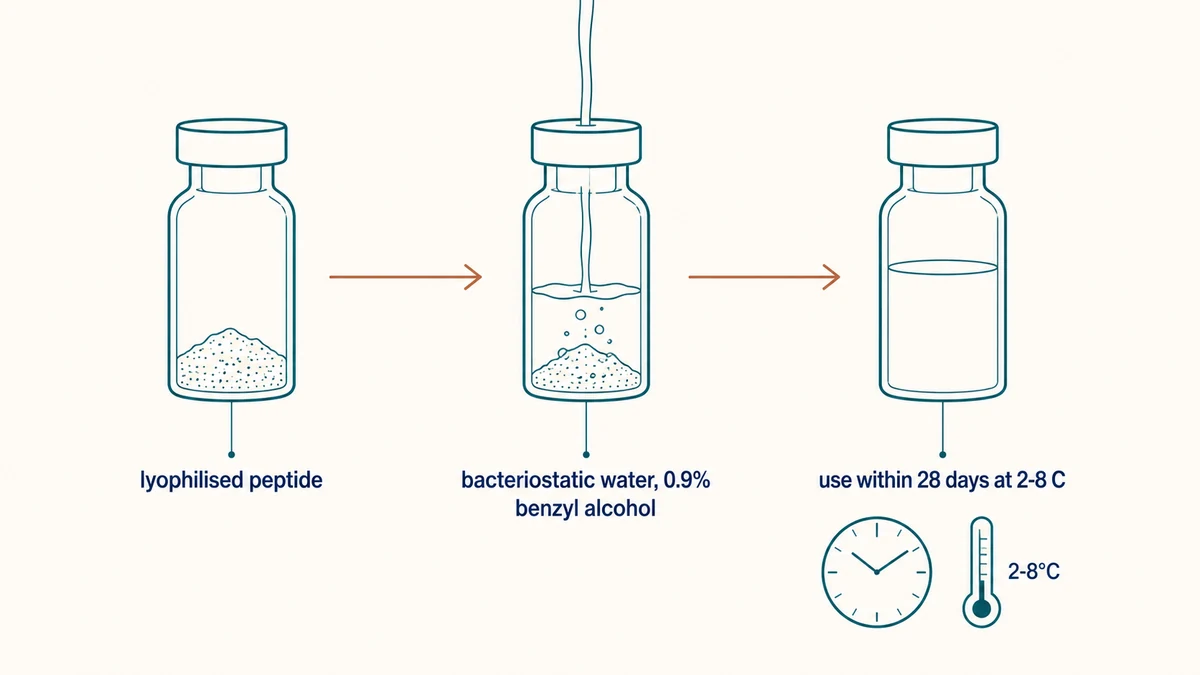
1. Let the vial reach room temperature before opening, so moisture does not condense onto the powder. 2. Wipe both stoppers with an alcohol swab and let them dry. 3. Draw the calculated volume of solvent. 4. Direct the stream down the inside wall of the vial, not onto the powder. This is the step that matters most. 5. Let it dissolve on its own, swirling gently if needed. Do not shake. Foaming indicates denaturation, not mixing. 6. Inspect the solution. It should be clear. Cloudiness, visible particulates or persistent undissolved material mean the vial should not be used.
Storage and working life
Unopened bacteriostatic water is stable at room temperature until its printed expiry.
After first entry, the widely used convention is a 28-day working life under refrigeration, which derives from the preservative's documented effectiveness period rather than from the peptide's stability. Whichever expires first governs.
Reconstituted peptide is the shorter-lived of the two in almost every case. Store at 2-8 degrees C, protect from light, and avoid repeated freeze-thaw cycles - each cycle costs measurable activity. Where a batch-specific Certificate of Analysis states stability figures, those take precedence over any general guidance including this page. See our peptide storage and handling guide for compound-level detail and how to read a COA for interpreting batch documentation.
Conclusion
Bacteriostatic water is the least glamorous item in a peptide workflow and one of the few where the correct choice is unambiguous: preserved solvent for multi-entry vials, unpreserved for single use, and the label read rather than assumed. The arithmetic is trivial, the technique is mechanical, and both are worth getting right because every downstream measurement inherits the error.
The reagent itself is a lab consumable rather than a research compound, and it carries none of the regulatory complexity of the peptides it dissolves. That does not make it optional - a correctly synthesised, correctly certified peptide can still be ruined in the thirty seconds it takes to reconstitute it badly.
Research source
Source Bacteriostatic Water for your research
Lab-tested, ≥99% HPLC purity. Certificate of Analysis available per batch.
View productFrequently Asked Questions
What is the difference between bacteriostatic water and sterile water?
Bacteriostatic water contains 0.9% benzyl alcohol as a preservative; sterile water contains nothing but water. The preservative inhibits bacterial growth, which allows a vial to be entered more than once. Sterile water is single-entry only, and is the right choice when the preservative would interfere with the work.
How long does bacteriostatic water last after opening?
The commonly applied convention is 28 days refrigerated after first entry, based on the preservative's documented effectiveness period. The reconstituted peptide is usually the shorter-lived component, so whichever expires first governs. Batch-specific COA figures take precedence over general guidance.
How much bacteriostatic water should be added to a vial?
Enough to reach the concentration the protocol calls for: concentration equals the mass in the vial divided by the volume added. A 10 mg vial with 2 ml gives 5 mg/ml; the same vial with 1 ml gives 10 mg/ml. Vial headroom limits the maximum volume, and more dilute stocks require larger withdrawals per use.
Can bacteriostatic water be used with every peptide?
Not universally. A minority of sequences are sensitive to benzyl alcohol, and some assays are confounded by organic solvents. Where a protocol specifies unpreserved Sterile Water for Injection, that specification generally exists for a reason and should be followed rather than substituted.
Why should the vial not be shaken after adding solvent?
Shaking introduces shear forces that denature peptides, and the foaming it produces is a sign of damage rather than mixing. Direct the solvent down the inside wall of the vial and let the material dissolve on its own, swirling gently if necessary.
Is bacteriostatic water a research compound?
No. It is a laboratory consumable - sterile water with a preservative - and it carries none of the regulatory framing of the research peptides it is used to dissolve. This page is handling guidance for laboratory work and is not clinical or dosing instruction.
Scientific References
- United States Pharmacopeia. Bacteriostatic Water for Injection, USP monograph. USP-NF.
- Gershanik J, Boecler B, Ensley H, McCloskey S, George W. The gasping syndrome and benzyl alcohol poisoning. N Engl J Med. 1982;307(22):1384-1388. PMID: 7133084[PubMed Reference]
- Manning MC, Chou DK, Murphy BM, Payne RW, Katayama DS. Stability of protein pharmaceuticals: an update. Pharm Res. 2010;27(4):544-575. PMID: 20143256[PubMed Reference]