BPC-157 vs TB-500: Mechanisms & Research Compared
BPC-157 and TB-500 are the two most commonly investigated synthetic peptides in preclinical tissue-repair research. Both are short, both are supplied as lyophilized white powders for in vitro and animal use, and both appear repeatedly in the same tendon, muscle, and wound-healing model literature. Beneath that surface similarity, however, they are genuinely different molecules: BPC-157 is a 15-amino-acid sequence isolated from a cytoprotective fraction of human gastric juice and characterized by Predrag Sikiric and the Zagreb group, while TB-500 is a seven-amino-acid synthetic fragment of the 43-residue actin-sequestering protein Thymosin Beta-4 (Tβ4), originally isolated from calf thymus by Allan Goldstein and colleagues.
The two peptides are frequently presented as interchangeable healing agents in popular peptide commentary. The peer-reviewed literature does not support that framing. BPC-157 and TB-500 act on different molecular machinery, have different pharmacokinetic profiles, dominate in different injury models, and carry different regulatory classifications. Researchers selecting between them - or planning to use both - benefit from understanding where each compound's evidence base is strongest and where it is thin.
This article compares the two peptides head-to-head across mechanism, pharmacokinetics, published evidence, regulatory status, and protocol selection. It is written strictly for research-context decision support: nothing here is a recommendation for human use, and all dose figures cited are reproduced from published animal and in vitro work for protocol-design reference only. See our research disclaimer for full context.
Quick Comparison Table
The table below summarizes the principal differences between BPC-157 and TB-500 as they appear in the peer-reviewed literature. Each row is expanded in the sections that follow. Dose ranges are reproduced from published animal and in vitro studies and are not human dosing recommendations.
| Attribute | BPC-157 | TB-500 |
|---|---|---|
| Origin / source | Cytoprotective fraction of human gastric juice | Synthetic fragment of bovine / human Thymosin Beta-4 (Tβ4) |
| Length | 15 amino acids | 7 amino acids (the LKKTETQ fragment); 43 for full Tbeta4 |
| Primary mechanism | VEGFR2 internalization, EGR-1 / FAK-paxillin signaling, NO rebalancing | G-actin sequestration via LKKTETQ motif; cell migration |
| Best-studied research application | Tendon, ligament, gastrointestinal protection | Cardiac repair, dermal / corneal wound healing |
| Plasma half-life | ~4 minutes (rat, IV) | ~2-3 hours (rat, SC / IM) |
| Typical animal / in vitro dose range | 10 ng/kg - 10 µg/kg | 60-600 µg/kg or 150 µg/dose |
| WADA status | Not on prohibited list as of latest WADA update (subject to change) | Prohibited at all times under class S2 |
| Regulatory status | No FDA / EMA approval; FDA 503A Category 2 (2023) | No FDA / EMA approval for the fragment |
| Common research format | Lyophilized 5 mg / 10 mg vial, >=99% HPLC | Lyophilized 5 mg / 10 mg vial, >=99% HPLC |
For the full BPC-157 mechanism review, see BPC-157 tissue repair mechanisms; for the parallel TB-500 review, see TB-500 cellular migration and tissue repair.
Mechanism Comparison
The clearest distinction between BPC-157 and TB-500 is mechanistic. They act on different cellular components, through different signaling logic, and with different kinetic profiles. The two H3 sections below summarize each peptide's primary mechanism, followed by a synthesis on how the two profiles relate.
How BPC-157 Works
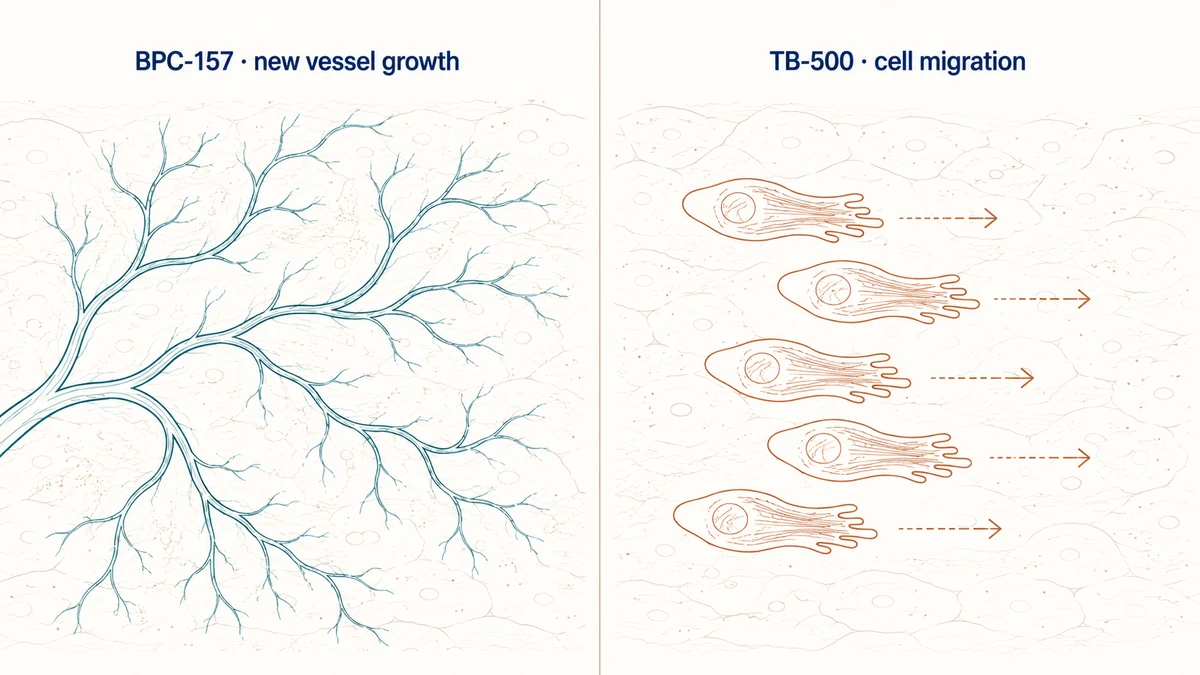
BPC-157 has no identified high-affinity receptor and no canonical endogenous ligand counterpart. The current mechanistic picture, assembled from Sikiric-group reviews and independent confirmatory work (Chang 2011, 2014; Gwyer 2019; Hsieh 2017), describes a coordinated effect on vascular and fibroblast biology. The most reproducible single mechanism is non-canonical activation of the VEGFR2-Akt-eNOS axis: Hsieh and colleagues showed that BPC-157 induces VEGFR2 internalization and downstream signaling in endothelial cells in the absence of VEGF, supporting capillary outgrowth in the wound bed. Chang and colleagues separately documented upregulation of EGR-1 and engagement of the FAK-paxillin focal-adhesion pathway in tendon fibroblasts, with corresponding increases in proliferation and migration in scratch-wound assays. A third recurring strand is bidirectional nitric oxide system rebalancing - BPC-157 counteracts both L-NAME-induced NOS blockade and L-arginine substrate overload in rat models. CNS effects on dopaminergic and serotonergic systems are documented in injury models but remain less mechanistically resolved. Functionally, BPC-157 looks most like a multi-pathway angiogenic and growth-factor-receptor modulator with broad tissue specificity.
How TB-500 Works
TB-500 acts through a single, structurally well-defined biochemical activity: 1:1 sequestration of monomeric (G-) actin via the conserved LKKTETQ alpha-helix preserved in the fragment. This activity was characterized at the structural level by Kleinman and colleagues at the NIH and is the defining function of the parent Thymosin Beta-4 protein. By regulating the unpolymerized actin pool, TB-500 acts as a rheostat for cytoskeletal remodeling: on migration or repair signals, sequestered G-actin is released and polymerized at the leading edge of moving cells. Functionally this manifests as directional cell migration - endothelial cells, keratinocytes, fibroblasts, and cardiac progenitors all migrate more efficiently in TB-500-treated models (Sosne 2002, 2010; Bock-Marquette 2004; Malinda 1999). Secondary effects include NF-κB-dependent anti-inflammatory signaling and angiogenic outgrowth driven by endothelial migration into the wound bed. The mechanism is intracellular, structurally specific, and narrower in scope than BPC-157's multi-pathway profile.
Why the Two Profiles Are Complementary
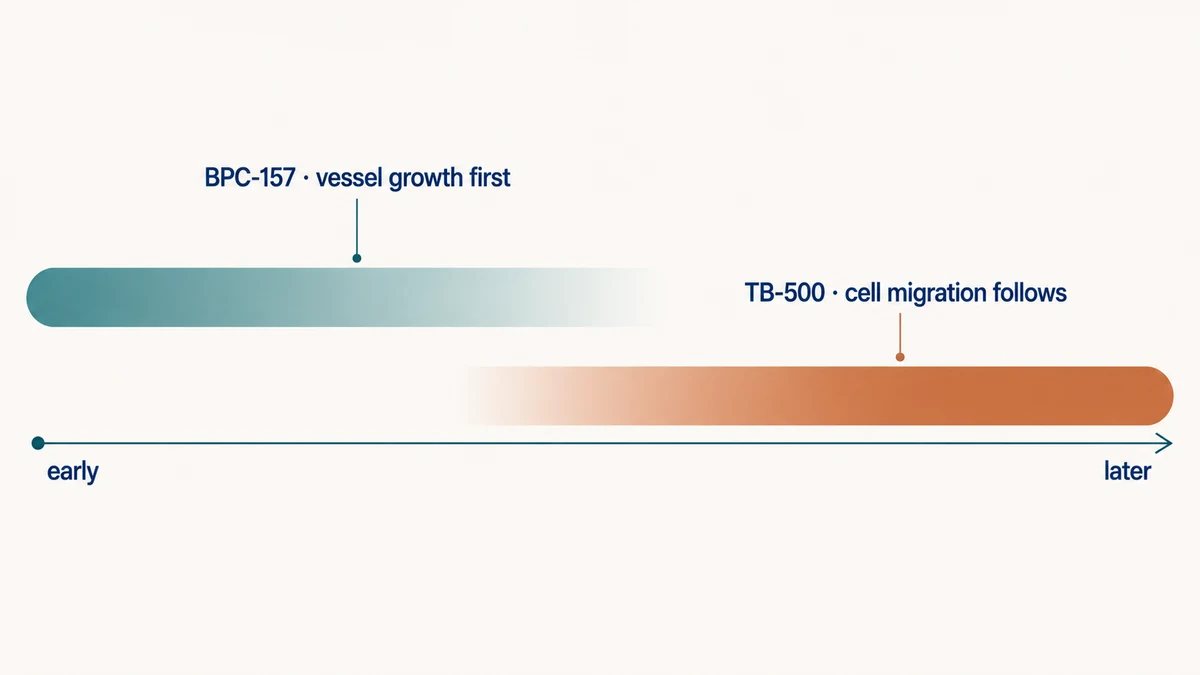
BPC-157 and TB-500 do not act through overlapping pathways. BPC-157 operates upstream and at the cell surface - modulating growth-factor receptor signaling, transcription factor expression, and vascular tone - while TB-500 operates inside the cell, regulating the cytoskeletal substrate that allows the cells responding to those signals to actually migrate into the repair zone. In a tissue-repair model that requires both revascularization and cellular ingress (tendon, muscle crush, dermal wound), the two mechanisms are mechanistically additive rather than redundant. This is the standard rationale offered for stacking the two compounds in preclinical work; rigorous solo-vs-combined trials remain rare, and most stacking claims rest on mechanistic plausibility rather than direct head-to-head data (see stacking review).
Research Evidence Side-by-Side
The published evidence base supports each peptide more strongly in different injury models. The subsections below summarize the strongest application area for each compound and note where the literature is thin.
Tendon and Ligament Repair
Both peptides have published preclinical data in tendon and ligament injury, and this is the model class where stacking is most often discussed. BPC-157 has the deeper dataset here, anchored by Chang et al. (2011) on Achilles tendon transection in rats and Chang et al. (2014) on tendon fibroblast outgrowth and FAK-paxillin signaling. TB-500 is supported by Xu et al. (2018) on rat Achilles tendon injury and by the broader Tβ4 fibroblast-migration literature. In published tendon models, BPC-157's evidence is more granular at the mechanism level, while TB-500's contribution is best characterized as accelerated migratory infiltration. Neither has been compared head-to-head in a controlled tendon trial.
Wound Healing and Skin
TB-500 / Tβ4 dominates the dermal and corneal wound-healing literature. Malinda et al. (1999), Philp et al. (2003) on db/db diabetic and aged mice, and the Sosne corneal series (2002, 2005, 2010) form a coherent body of work demonstrating accelerated re-epithelialization, reduced inflammatory infiltration, and improved wound closure with topical, SC, or IM administration. BPC-157 has dermal data but is less concentrated in this area; its core literature centers on internal tissue repair rather than skin specifically. For dermal models, TB-500 is the more rigorously supported tool.
Cardiac Tissue Repair
TB-500 dominates this area decisively. The keystone paper is *Bock-Marquette et al. (2004), Nature***, reporting Tβ4-driven cardiac progenitor migration, capillary formation, and improved functional outcomes after experimental myocardial infarction in mice. Smart et al. (2007) extended this to hindlimb ischemia. The cardiac repair story is one of the strongest in the entire Tβ4 literature and was the motivating finding for several registered Tβ4 clinical programs. BPC-157 has scattered cardiac data - primarily in vasculogenesis-after-occlusion contexts - but does not approach TB-500's depth in cardiac progenitor biology specifically.
Gastrointestinal Protection
BPC-157 dominates this area. The Sikiric group has published extensively on gastric ulcer, TNBS-induced colitis, and hepatic ischemia-reperfusion models (Sikiric et al. 2010, 2018, 2020; Park et al. 2020), with reproducible cytoprotective effects across the entire GI tract and consistent activity by both parenteral and oral routes. This is also the original characterization context - BPC-157 was isolated from gastric juice and characterized first in gastric protection models. TB-500 has comparatively little GI literature, and the actin-sequestration mechanism is not well-suited to the cytoprotective questions BPC-157 addresses in this domain.
Cognitive and Neuroprotective Models
BPC-157 has emerging neuroprotective data, primarily from the Zagreb group and including Vukojević et al. (2022, Frontiers in Pharmacology) on rat middle-cerebral-artery-occlusion stroke, plus reviews summarizing effects in traumatic brain injury and spinal cord lesion models with mechanistic links to NO and dopaminergic system modulation. TB-500 has limited published CNS-injury work and is not commonly used in neurological repair models. Researchers studying neurological repair should treat BPC-157 as the more developed tool here, while recognizing that this evidence base is still narrower than its tendon and GI literature.
Pharmacokinetics Comparison
The two peptides differ substantially in pharmacokinetic profile, which influences dosing frequency in published preclinical protocols.
BPC-157 has a plasma half-life of approximately 4 minutes after intravenous administration in rats (figure referenced in Vukojević et al. 2022 and earlier Zagreb dossiers). Despite this, biological effects on VEGFR2 signaling, EGR-1 transcription, and tissue repair persist for hours to days after a single dose, suggesting effects are mediated by rapid signaling cascades whose downstream consequences outlast the parent compound. BPC-157 is unusually stable in human gastric juice for over 24 hours, making it one of the few peptides with documented oral activity in animal models. SC, IM, IP, and oral routes are all used in the published literature, with SC and IM most common.
TB-500's pharmacokinetics reflect its actin-binding behavior. After SC or IM administration in rats, plasma half-life is on the order of two to three hours - substantially longer than BPC-157 - followed by tissue redistribution toward sites of active injury. The longer effective tissue exposure is consistent with the actin-sequestration mechanism, which depends on intracellular accumulation rather than transient extracellular signaling. Topical and locally injected delivery are well represented in the dermal and corneal literature alongside systemic SC and IM. Oral activity has not been demonstrated for TB-500; it is not characterized as resistant to gastric proteolysis. No human PK has been published for the fragment specifically.
Stacking - When Researchers Use Both
Many preclinical protocols pair BPC-157 and TB-500 in tendon, muscle, and combined soft-tissue injury models. The rationale, summarized in our BPC-157 + TB-500 stacking review, is mechanistic complementarity rather than additive potency at a single target: BPC-157 drives revascularization and growth-factor receptor signaling at and around the wound bed, while TB-500 accelerates migration of fibroblasts, endothelial cells, and progenitors into that bed. The two effects address different rate-limiting steps of repair.
The practical caveat is that rigorous head-to-head solo-vs-combined trials remain rare in the peer-reviewed literature. Most stacking claims rest on mechanistic plausibility, individual-compound efficacy data in matched models, and the practical observation that the two compounds produce no obvious antagonism in co-administration. Researchers should treat combined-use protocols as exploratory and design with appropriate single-compound controls. Stacking does not multiply the regulatory or safety concerns of either compound but does compound the research-only status of both - neither has FDA or EMA approval, and TB-500 specifically is on the WADA Prohibited List.
Safety and Regulatory Differences
Both BPC-157 and TB-500 carry similar broad regulatory characterizations - neither has FDA or EMA approval for human use, both are sold strictly as research chemicals for in vitro and animal-model investigation - but the specific regulatory facts differ.
BPC-157 was placed by the U.S. FDA on the 503A bulk substances Category 2 list in 2023, removing it from compounding pharmacy eligibility on the grounds that human safety, immunogenicity, and PK data were insufficient. As of the latest WADA update, BPC-157 is not listed on the WADA Prohibited List; this classification can be reviewed and is subject to change in future WADA cycles. No animal study has reported acute toxicity at therapeutic doses, but no controlled human trial has been published.
TB-500 has no FDA or EMA approval for the fragment and is on the WADA Prohibited List under class S2 (peptide hormones, growth factors, and mimetics) - banned in competitive sport at all times. This is stated as a factual regulatory matter. Full Tβ4 (not the fragment) has progressed through phase II human trials in dry eye and dermal indications without serious safety signals, providing some collateral safety data, but those results should not be extrapolated directly to the synthetic TB-500 fragment.
Neither compound is a pharmaceutical, and neither should be used outside research-protocol contexts. See our disclaimer for full research-use framing.
How to Choose for Your Research
The decision between BPC-157, TB-500, or a combined protocol depends on the biological question, not on which compound is broadly 'better'. The two peptides have complementary, non-overlapping mechanisms, and the literature supports each more strongly in different model classes.
- Studying gastrointestinal protection, gastric or hepatic ischemia, or general cytoprotection? BPC-157 has by far the deeper evidence base and is the well-characterized tool of choice. The actin-sequestration mechanism of TB-500 is not well-suited to cytoprotective questions of this type.
- Studying cardiac progenitor biology, post-MI repair, or dermal / corneal wound healing? TB-500 (or full Tβ4) has the dominant published record. The Bock-Marquette 2004 Nature paper and the Sosne corneal series anchor these areas.
- Studying tendon, ligament, or muscle repair? Both compounds have published data, with BPC-157 the more mechanistically detailed in tendon fibroblast biology and TB-500 strong in migratory contributions. Many investigators in this space use both, with appropriate single-compound controls.
- Studying neurological repair? BPC-157 has emerging stroke and CNS-injury data; TB-500 does not.
- Concerned about WADA classification or working in a sport-adjacent research context? TB-500 is prohibited at all times under class S2; BPC-157 is not currently listed but classification is not permanent.
This is a research-selection framework. Nothing in this section is a recommendation for human use of either compound; both remain strictly research-use-only.
Conclusion
BPC-157 and TB-500 are often grouped together in popular peptide discussion, but the peer-reviewed literature treats them as distinct tools with non-overlapping mechanisms, different evidence bases, and different regulatory classifications. BPC-157 is a multi-pathway angiogenic and growth-factor-receptor modulator with the deepest preclinical evidence in gastrointestinal protection, tendon repair, and emerging neurological models. TB-500 is a structurally specific G-actin sequestering peptide with the strongest evidence in cardiac progenitor biology, dermal and corneal wound healing, and migratory contributions to soft-tissue repair. They are not interchangeable; the right choice depends on the research question.
For combined protocols, mechanistic complementarity is well-established, but rigorous head-to-head solo-vs-combined data remains rare. Researchers should design stacking work with appropriate controls. All use must remain within research-only boundaries - neither compound is approved by the FDA or EMA, BPC-157 was placed on the FDA 503A Category 2 list in 2023, and TB-500 is on the WADA Prohibited List under class S2. See our research disclaimer and the deeper individual reviews of BPC-157 and TB-500 for full context.
Source this peptide for your research
Order BPC-157 at Baltic PeptidesResearch source
Source BPC-157 for your research
Lab-tested, ≥99% HPLC purity. Certificate of Analysis available per batch.
View productFrequently Asked Questions
Which is better - BPC-157 or TB-500?
Neither is universally 'better'. They have different mechanisms and different evidence bases. BPC-157 has the stronger published record in gastrointestinal protection, tendon repair, and emerging neurological models. TB-500 has the stronger record in cardiac progenitor biology and dermal / corneal wound healing. The right choice depends on the specific research question and model system. For some tissue-repair models, the literature supports investigating both in parallel.
Can BPC-157 and TB-500 be used together in research protocols?
Yes - combined use is common in preclinical tendon, muscle, and soft-tissue repair research because the two mechanisms are complementary rather than overlapping. BPC-157 drives revascularization and growth-factor receptor signaling, while TB-500 drives cytoskeletal remodeling and cell migration. However, rigorous controlled head-to-head solo-vs-combined trials remain rare, and most stacking claims rest on mechanistic plausibility plus individual-compound efficacy data. See our stacking protocol review for deeper coverage.
Are BPC-157 and TB-500 the same molecule?
No. BPC-157 is a 15-amino-acid synthetic peptide derived from a cytoprotective fraction of human gastric juice. TB-500 is a seven-amino-acid synthetic fragment of Thymosin Beta-4 (Tβ4), a 43-residue actin-binding protein. They have different sequences, different parent proteins, different mechanisms, and different pharmacokinetic profiles.
Is TB-500 the same as Thymosin Beta-4?
Not exactly. Thymosin Beta-4 (Tβ4) is the full 43-amino-acid endogenous actin-sequestering protein originally isolated from calf thymus. TB-500 is a seven-amino-acid synthetic fragment containing the central LKKTETQ actin-binding motif of Tβ4. The fragment reproduces the cytoskeletal and migratory effects of full Tβ4 in preclinical models but does not include all of the parent protein's non-actin functions.
What are the half-life differences?
BPC-157 has an extremely short plasma half-life - approximately 4 minutes after intravenous administration in rats - although downstream effects persist for hours to days. TB-500 has a substantially longer plasma half-life, approximately two to three hours after subcutaneous or intramuscular administration in rats, followed by tissue redistribution. This difference influences dosing frequency in published animal protocols.
What is the WADA status of BPC-157 and TB-500?
TB-500 is on the WADA Prohibited List under class S2 (peptide hormones, growth factors, and mimetics) and is banned in competitive sport at all times. BPC-157 is not on the WADA Prohibited List as of the latest WADA update, although classification is reviewed in each WADA cycle and is subject to change. Both statements are factual regulatory information, not recommendations.
Where can I source research-grade BPC-157 and TB-500?
Reputable research suppliers certify both peptides at >=99% purity by HPLC, with identity confirmed by mass spectrometry on a per-batch basis. Always review the Certificate of Analysis for the specific lot before incorporating either peptide into a study protocol. Baltic BioLabs publishes batch-level lab reports for its BPC-157 and TB-500 lines.
Scientific References
- Sikiric P, Skrtic A, Gojkovic S, et al. Cytoprotective gastric pentadecapeptide BPC 157 resolves major vessel occlusion disturbances, ischemia-reperfusion injury following Pringle maneuver, and Budd-Chiari syndrome. World J Gastroenterol. 2022;28(1):23-46. PMID: 35125818[PubMed Reference]
- Chang CH, Tsai WC, Lin MS, et al. The promoting effect of pentadecapeptide BPC 157 on tendon healing involves tendon outgrowth, cell survival, and cell migration. J Appl Physiol. 2011;110(3):774-780. PMID: 21030672[PubMed Reference]
- Chang CH, Tsai WC, Hsu YH, Pang JH. Pentadecapeptide BPC 157 enhances the growth hormone receptor expression in tendon fibroblasts. Molecules. 2014;19(11):19066-19077. PMID: 25415472[PubMed Reference]
- Gwyer D, Wragg NM, Wilson SL. Gastric pentadecapeptide body protection compound BPC 157 and its role in accelerating musculoskeletal soft tissue healing. Cell Tissue Res. 2019;377(2):153-159. PMID: 30915550[PubMed Reference]
- Vukojević J, Milavić M, Perović D, et al. Pentadecapeptide BPC 157 and the central nervous system. Neural Regen Res. 2022;17(3):482-487. PMID: 34380875[PubMed Reference]
- Sikiric P, Skrtic A, Gojkovic S, et al. Stable gastric pentadecapeptide BPC 157 as a therapy: from gastric ulcer to multi-organ injury. Curr Med Chem. 2022;29(11):1845-1872
- Bock-Marquette I, Saxena A, White MD, et al. Thymosin beta4 activates integrin-linked kinase and promotes cardiac cell migration, survival and cardiac repair. Nature. 2004;432(7016):466-472. PMID: 15565145[PubMed Reference]
- Goldstein AL, Hannappel E, Kleinman HK. Thymosin beta4: actin-sequestering protein moonlights to repair injured tissues. Trends Mol Med. 2005;11(9):421-429. PMID: 16099219[PubMed Reference]
- Sosne G, Qiu P, Goldstein AL, Wheater M. Biological activities of thymosin beta4 defined by active sites in short peptide sequences. FASEB J. 2010;24(7):2144-2151. PMID: 20179146[PubMed Reference]
- Malinda KM, Sidhu GS, Mani H, et al. Thymosin beta4 accelerates wound healing. J Invest Dermatol. 1999;113(3):364-368. PMID: 10469335[PubMed Reference]
- Philp D, Badamchian M, Scheremeta B, et al. Thymosin beta 4 and a synthetic peptide containing its actin-binding domain promote dermal wound repair in db/db diabetic mice and in aged mice. Wound Repair Regen. 2003;11(1):19-24. PMID: 12581423[PubMed Reference]
- Crockford D, Turjman N, Allan C, Angel J. Thymosin beta4: structure, function, and biological properties supporting current and future clinical applications. Ann N Y Acad Sci. 2010;1194:179-189. PMID: 20536467[PubMed Reference]
Related Research Peptides
BPC-157
TB-500