BPC-157 + GHK-Cu: Tissue Remodeling Research Compared
BPC-157 and GHK-Cu are studied in tissue-remodeling research through different experimental readouts. BPC-157 has been investigated for tendon-cell migration; GHK-Cu for collagen synthesis in fibroblast cultures. Comparing those findings helps select a laboratory question. The papers cited here tested the compounds separately, so they do not demonstrate a combined effect or synergy.
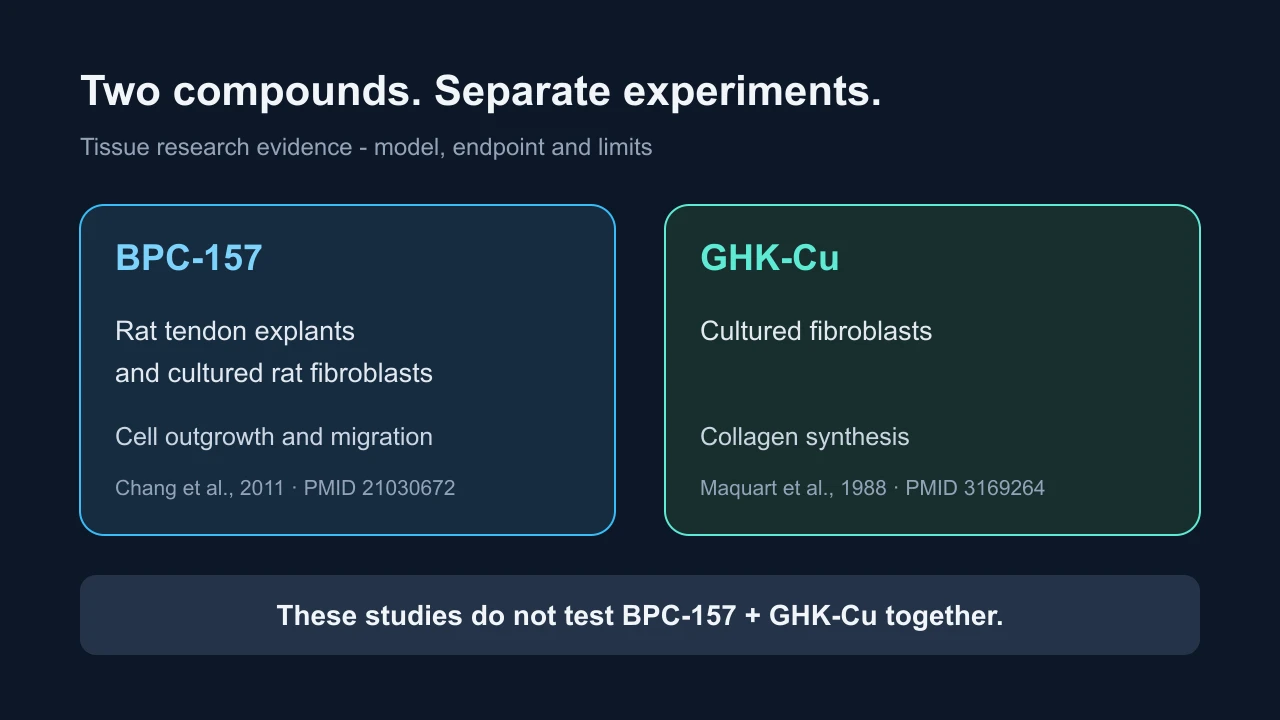
BPC-157 and GHK-Cu: what the cited studies measured
| Research question | BPC-157 | GHK-Cu |
|---|---|---|
| Molecular format | 15-amino-acid peptide | Glycyl-histidyl-lysine copper complex |
| Cited experiment | Chang et al., 2011 | Maquart et al., 1988 |
| Model | Rat Achilles-tendon explants and derived fibroblasts | Fibroblast cultures |
| Main readouts | Outgrowth, migration, spreading and survival under oxidative stress | Collagen synthesis |
| Mechanistic detail | FAK and paxillin phosphorylation examined | Collagen response examined independently of cell number |
| Combined BPC-157 + GHK-Cu group | Not part of this study | Not part of this study |
These are different experiments with different endpoints. Neither establishes a simple division where one peptide repairs all deep tissues and the other only the skin.
BPC-157: tendon-cell migration evidence
Chang and colleagues observed increased outgrowth from rat tendon explants and migration of cultured tendon fibroblasts after BPC-157 exposure. They also examined cell survival under oxidative stress and FAK-paxillin signalling. Importantly, the compound did not directly increase proliferation in their cultured-cell assay. Read the primary study.
This is an experimental basis for studying cell movement and stress responses. It is not a human postoperative recovery study. For more of the individual-compound literature, see BPC-157 tissue-repair mechanisms.
GHK-Cu: collagen-synthesis evidence
Maquart and colleagues reported that GHK-Cu stimulated collagen synthesis in fibroblast cultures. The response was not explained by an increase in cell number. This gives the study a specific matrix-related endpoint rather than a general claim about rejuvenation. Read the primary study.
A defined GHK-Cu complex also needs to be distinguished from a product labelled only as a copper-peptide complex, which can describe different formulations. See GHK-Cu versus Copper Peptide Complex for that selection question.
What a co-culture or combination study would need
A co-culture study uses two or more cell populations in the same experimental system. Testing two compounds together is a separate design choice; a mixture by itself is not a co-culture model.
To evaluate this pair, researchers would need to define the cells and endpoint, then compare a control, each compound alone and the combination under matched conditions. Migration, matrix production, viability and a functional repair outcome answer different questions. The analysis should state which one is being tested.
Calling the result synergistic would require an interaction analysis against the expected single-compound effects. Different mechanisms, or a catalogue blend containing both compounds, do not supply that evidence.
Choosing a tissue-remodeling research reagent
For a migration-focused experiment, the tendon-cell study gives a concrete BPC-157 starting point. For a collagen-synthesis question, the GHK-Cu fibroblast study is the more direct reference. Select the endpoint and model before deciding whether a mixture is useful.
Check the compound identity, copper-complex specification where applicable, and the certificate for the batch being considered. Keep analytical quality separate from biological efficacy: a certificate can document a sample, but it cannot establish that a proposed combination works. The batch-certificate guide explains that distinction.
Conclusion
The strongest comparison is between identifiable experiments: BPC-157 tendon-cell migration and GHK-Cu collagen synthesis. Use those results to frame a research question and choose appropriate readouts. Any claim about the pair needs its own combination evidence.
Source this peptide for your research
Order BPC-157 at Baltic PeptidesScientific References
- Chang CH, Tsai WC, Lin MS, Hsu YH, Pang JH. The promoting effect of pentadecapeptide BPC 157 on tendon healing involves tendon outgrowth, cell survival, and cell migration. J Appl Physiol. 2011;110(3):774-780. PMID: 21030672[PubMed Reference]
- Maquart FX, Pickart L, Laurent M, Gillery P, Monboisse JC, Borel JP. Stimulation of collagen synthesis in fibroblast cultures by the tripeptide-copper complex glycyl-L-histidyl-L-lysine-Cu2+. FEBS Lett. 1988;238(2):343-346. PMID: 3169264[PubMed Reference]
Related Research Peptides
BPC-157
GHK-Cu