
Cell-Penetrating Peptides + CRISPR Delivery
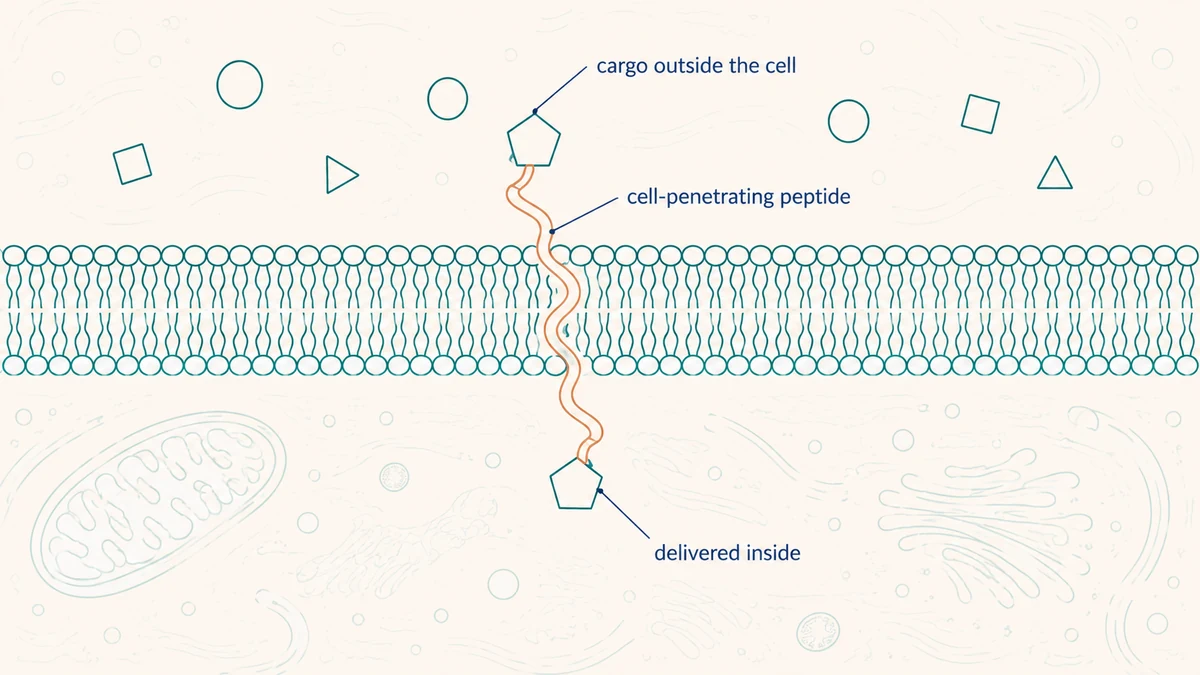
Cell-penetrating peptides are investigated as carriers for CRISPR components. Primary cell-culture studies have delivered Cas9 and guide RNA with peptide-based systems and measured gene editing. The important distinction is between material entering a cell and an editor reaching its target in a functional form. Carrier, cargo, cell type and the editing assay all matter.
Primary evidence for peptide-mediated Cas9 delivery
Ramakrishna and colleagues used CPP-conjugated Cas9 protein and CPP-complexed guide RNA in human cell lines. They measured endogenous gene disruption and compared off-target mutations with plasmid-mediated delivery. These were laboratory cell experiments, including cultured dermal fibroblasts and embryonic stem cells. Read the 2014 study.
A later study by Gustafsson and colleagues used PepFect14 with Cas9 ribonucleoprotein complexes. It reported editing in cultured cells and assessed results using restriction-enzyme analysis and next-generation sequencing. Read the 2021 study.
These studies provide concrete delivery approaches to compare. They do not show that every CPP, cargo or target cell will behave the same way.
CPPs and nuclear localization signals have different jobs
A cell-penetrating peptide is used to help deliver associated cargo into cells. A nuclear localization signal addresses a different step: targeting material toward the nucleus. The presence of an NLS does not by itself prove entry into a cell or escape from intracellular vesicles.
For Cas9 delivery, separate the questions of cellular uptake, intracellular release, nuclear access and functional editing. A fluorescent cargo signal alone cannot answer all four. Likewise, a reported increase in gene expression should not be treated as a CRISPR editing result without an appropriate assay.
How to compare a delivery experiment
| Stage | Useful question | Why it matters |
|---|---|---|
| Carrier and cargo | Which peptide and which form of Cas9/guide RNA were used? | Results belong to a defined formulation |
| Cellular uptake | Is the cargo inside the target cells? | Surface-associated signal can be misleading |
| Intracellular availability | Does cargo reach the compartment where it must act? | Uptake and functional access are different outcomes |
| Editing | Is the target sequence actually changed? | Delivery alone is not an editing endpoint |
| Specificity and viability | What happens to off-target sites and cell survival? | Editing efficiency alone is an incomplete comparison |
Compare matched controls and the same target cells before interpreting one carrier as better. The two cited papers illustrate different formulations and assays; they are not a universal ranking of delivery systems.
Where the research fits
Peptide-mediated CRISPR delivery is useful to investigate a defined cargo and cellular target. Moving from a cultured-cell result to an organism or clinical application adds questions about distribution, immune responses, formulation and exposure. A non-viral label alone does not establish safety or clinical superiority.
For a research plan, record the peptide sequence, cargo association method, target cell, endpoint and controls. Select materials for that experiment rather than assuming that a general-purpose peptide carrier can replace a validated delivery protocol.
Conclusion
CPP-mediated CRISPR work is strongest when delivery and editing are measured separately in a defined model. The primary studies above give specific starting points; the next step is to match their formulation and assay choices to the research question.
Scientific References
- Ramakrishna S, et al. Gene disruption by cell-penetrating peptide-mediated delivery of Cas9 protein and guide RNA. Genome Res. 2014;24(6):1020-1027. PMID: 24696462[PubMed Reference]
- Gustafsson O, et al. Efficient Peptide-Mediated In Vitro Delivery of Cas9 RNP. Pharmaceutics. 2021;13(6):878. PMID: 34198625[PubMed Reference]