GLP-1 + AOD-9604 Metabolic Mechanisms
GLP-1 receptor agonists and AOD-9604 belong to different areas of metabolic research. The useful comparison is their mechanism and evidence base: semaglutide has controlled human trial data, while the AOD-9604 experiment discussed here investigated lipid metabolism in mice. Separate pathways are a reason to ask a research question; they do not establish that combining compounds improves an outcome.
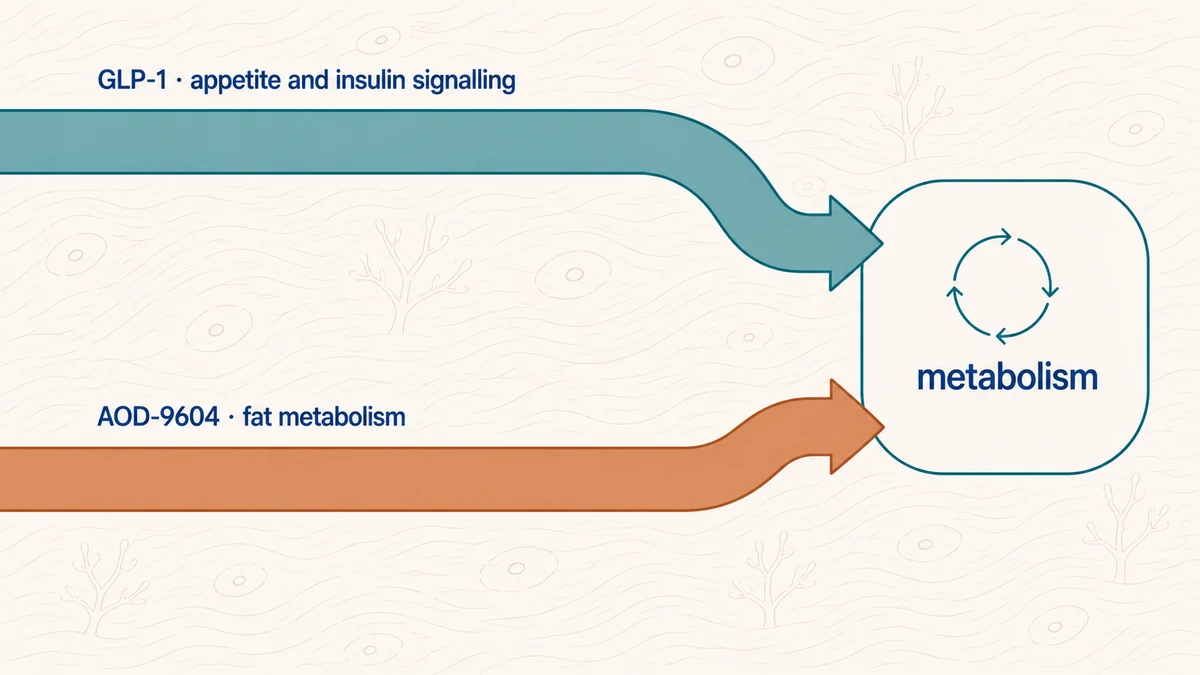
GLP-1 agonists and AOD-9604: the evidence side by side
| Question | GLP-1 receptor agonist example | AOD-9604 example |
|---|---|---|
| Compound in the cited study | Semaglutide | Modified growth-hormone fragment |
| Study model | Adults with overweight or obesity, without diabetes | Obese mice and beta-3-adrenoceptor knockout mice |
| Main comparison | Semaglutide versus placebo, alongside lifestyle intervention | AOD-9604 or human growth hormone versus experimental controls |
| Main outcome | Change in body weight over 68 weeks | Body weight, body fat and lipid-metabolism readouts |
| Does this test the two together? | No | No |
The rows describe the two papers below. They are not a head-to-head trial, and their results cannot be combined into a predicted effect size for a mixed protocol.
What the AOD-9604 mouse study found
Heffernan and colleagues studied AOD-9604 and human growth hormone in obese mice. After repeated experimental administration, they reported changes in weight, body fat and beta-3-adrenoceptor expression. Their knockout experiments helped distinguish receptor-associated changes from other effects on fat oxidation. Read the primary study.
This makes AOD-9604 relevant to lipid-metabolism research. It does not establish the same outcome in humans, a universal absence of hormonal effects, or a benefit from combining it with a GLP-1 agonist. The AOD-9604 research guide provides the broader fragment comparison.
How the GLP-1 evidence differs
The STEP 1 trial enrolled 1,961 adults without diabetes and compared semaglutide with placebo alongside lifestyle intervention. At 68 weeks, the mean body-weight change was -14.9% with semaglutide and -2.4% with placebo. These findings apply to that medicine, population and trial design. Read STEP 1.
A human trial outcome is a different level of evidence from a mouse lipid-metabolism experiment. It cannot validate an AOD-9604 combination or a research reagent purchased from a catalogue. For the separate incretin comparison, see semaglutide and tirzepatide research.
What would demonstrate a combination effect?
A useful combination experiment would need matched control, GLP-1-only, AOD-9604-only and combination groups, with the same model and predefined outcome measurements. To claim synergy, the analysis would also need to distinguish an interaction from the effects expected from each compound alone.
For laboratory selection, start with the endpoint: receptor signalling, lipid turnover or a measured whole-organism response. Keep the study model, analytical identity and individual compound results explicit. A mixture is not evidence that the components have been tested together.
AOD-9604 and the FDA GRAS distinction
In its 4 December 2024 advisory-committee discussion, the FDA distinguished the company's GRAS self-determination from an FDA GRAS determination for AOD-9604. The relevant passage is Topic 2, printed page 57. Read the FDA transcript.
A food-use assessment is also a different question from approval or evidence for a medicinal use. It should not be used as a shortcut to describing an AOD-9604 and GLP-1 protocol as established treatment.
Conclusion
Choose the research question before the compound or combination. GLP-1 signalling and AOD-9604 lipid-metabolism findings offer different lines of investigation, and the cited studies make their models and endpoints identifiable. Their separate results support a comparison of evidence, not a clinical claim about the pair.
Scientific References
- Heffernan M, et al. The effects of human GH and its lipolytic fragment (AOD9604) on lipid metabolism following chronic treatment in obese mice and beta(3)-AR knock-out mice. Endocrinology. 2001;142(12):5182-5189. PMID: 11713213[PubMed Reference]
- Wilding JPH, et al. Once-Weekly Semaglutide in Adults with Overweight or Obesity. N Engl J Med. 2021;384(11):989-1002. PMID: 33567185[PubMed Reference]
- FDA. Pharmacy Compounding Advisory Committee meeting, 4 December 2024. Topic 2, p. 57. Meeting transcript.
Related Research Peptides
AOD9604
Retatrutide