MOTS-c Mitochondrial Signaling Research
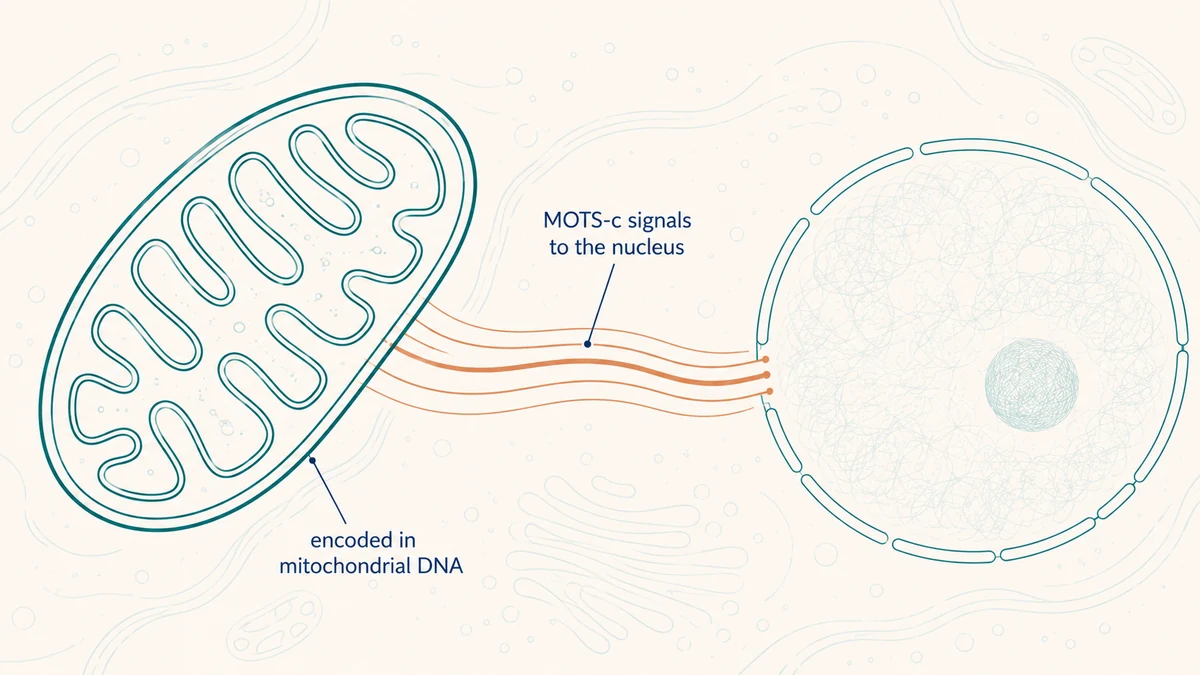
MOTS-c is a 16-amino-acid peptide encoded within the mitochondrial 12S rRNA region. Its research interest comes from metabolic signalling and communication with the nucleus. The central distinction is between experimental effects of administered MOTS-c in mice, measurements of naturally occurring MOTS-c in humans, and evidence for administering it to people.
MOTS-c mechanisms: metabolic signalling and the nucleus
Lee and colleagues identified MOTS-c in 2015 and investigated metabolic effects in cellular experiments and mice. They reported AMPK-associated changes and protection against diet- and age-related insulin resistance in the studied mouse models. Read the discovery study.
Kim and colleagues subsequently showed that MOTS-c could translocate to the nucleus during metabolic stress and regulate stress-responsive gene expression in their experimental systems. Read the nuclear-signalling study.
Mitochondrial origin therefore does not mean that all its effects occur inside the mitochondrion, or that it has been shown to improve every aspect of energy production.
Exercise findings: mouse administration versus human observations
Reynolds and colleagues reported effects of administered MOTS-c on physical performance in mice. They also observed increases in endogenous MOTS-c in skeletal muscle and circulation after cycling exercise in ten healthy, sedentary young men. Read the 2021 study.
Those are two different findings. Measuring a peptide that the body produces during exercise does not test injecting or otherwise administering that peptide to people. Calling MOTS-c an exercise mimetic should not imply that a reagent reproduces the established benefits of exercise in humans.
The MOTS-c evidence map
| Evidence | Model or population | What it informs |
|---|---|---|
| Lee et al., 2015 | Cellular experiments and mice | Metabolic signalling and insulin-resistance research |
| Kim et al., 2018 | Experimental metabolic-stress models | Nuclear translocation and gene regulation |
| Reynolds et al., 2021: administration | Mice | Physical-performance and muscle-homeostasis research |
| Reynolds et al., 2021: exercise observations | Ten healthy, sedentary young men | Changes in endogenous MOTS-c after exercise |
Keep model, administration and outcome explicit when comparing results. The human observation row is not a trial of a MOTS-c product.
MOTS-c, GLP-1 and research selection
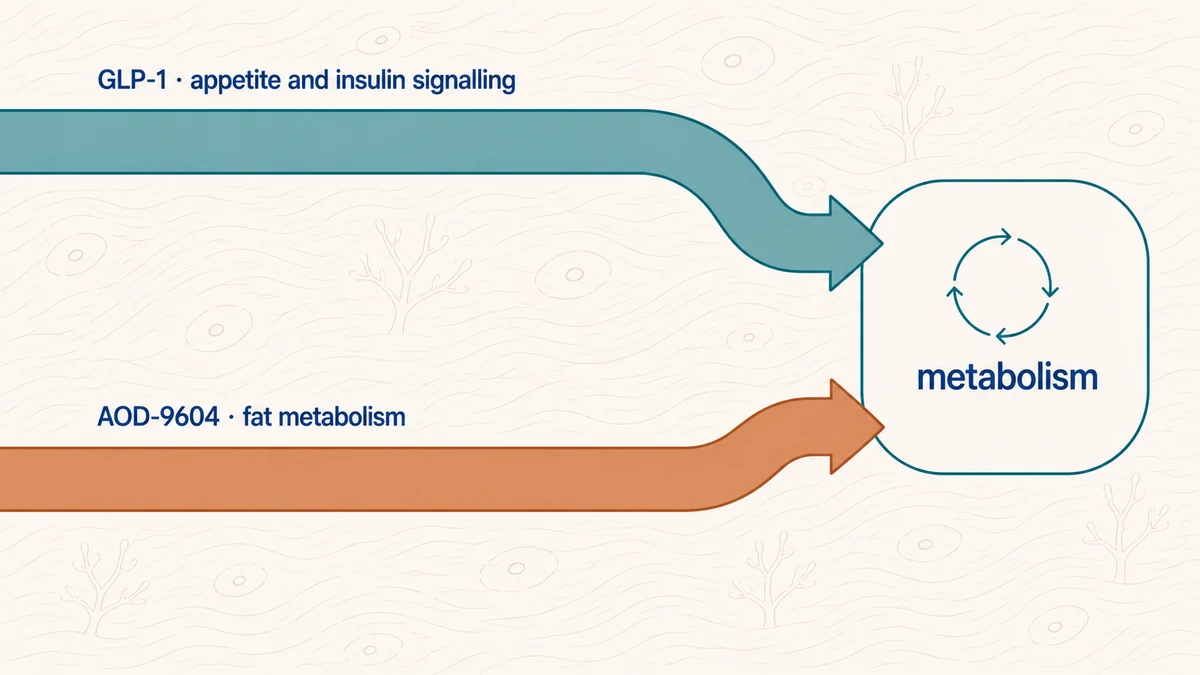
MOTS-c signalling research and GLP-1 receptor-agonist research address different mechanisms and have different evidence bases. The MOTS-c studies cited here do not test a GLP-1 combination. Mechanistic differences can motivate an experiment, but cannot establish a combined benefit.
Start with the question: metabolic stress, AMPK-associated signalling, gene expression or a measured organism-level endpoint. For the separate incretin literature, see semaglutide and tirzepatide research. For a related mitochondrial research topic, see NAD+ and mitochondrial function.
Human evidence and the regulatory distinction
The FDA's July 2026 advisory-committee material reported a lack of identified clinical studies evaluating administration of the nominated MOTS-c substances to humans, as well as gaps in clinical pharmacokinetic and safety information. This is a dated assessment of the nominated substances, not a rule for every jurisdiction. Read the MOTS-c section of the FDA material.
An advisory-committee discussion, a compounding category and marketing authorisation are separate questions. A prediction about a category change does not establish approval or a demonstrated therapeutic use. The laboratory evidence above should be read on its own terms.
Conclusion
MOTS-c provides a defined research subject for metabolic signalling, stress responses and mitochondrial-to-nuclear communication. Select it according to the model and measurable endpoint, and keep human exercise observations separate from experiments that administer the peptide.
Source this peptide for your research
Order MOTS-C at Baltic PeptidesScientific References
- Lee C, et al. The mitochondrial-derived peptide MOTS-c promotes metabolic homeostasis and reduces obesity and insulin resistance. Cell Metab. 2015;21(3):443-454. PMID: 25738459[PubMed Reference]
- Kim KH, Son JM, Benayoun BA, Lee C. The Mitochondrial-Encoded Peptide MOTS-c Translocates to the Nucleus to Regulate Nuclear Gene Expression in Response to Metabolic Stress. Cell Metab. 2018;28(3):516-524.e7. PMID: 29983246[PubMed Reference]
- Reynolds JC, et al. MOTS-c is an exercise-induced mitochondrial-encoded regulator of age-dependent physical decline and muscle homeostasis. Nat Commun. 2021;12:470. PMID: 33473109[PubMed Reference]
- FDA. Pharmacy Compounding Advisory Committee, 23–24 July 2026. MOTS-c assessment, clinical effectiveness and safety. Meeting material.
Related Research Peptides
MOTS-C
NAD+